
True financial mastery isn’t achieved by looking at your bank account once a month and feeling stressed about the final balance; it is built through the small, intentional decisions you make every single day. If you find yourself consistently wondering why your money vanishes despite having a solid monthly budget plan, the culprit is likely hidden within your micro-transactions. To bring absolute transparency to your cash flow, utilizing a high-quality daily expense tracker printable is one of the most effective, behavior-shifting habits you can adopt.
Whether you want to eliminate mindless impulse spending, teach yourself better money management habits, manage a highly volatile freelance cash flow, or maintain an airtight household budget tracker, logging your purchases on paper gives you ultimate control. This free, beautifully formatted worksheet is created in standard US Letter size (8.5 × 11 inches). It is optimized to slide right into your primary finance notebook, budget binder, or daily planner so your real-time spending habits remain exactly where they belong: front and center.
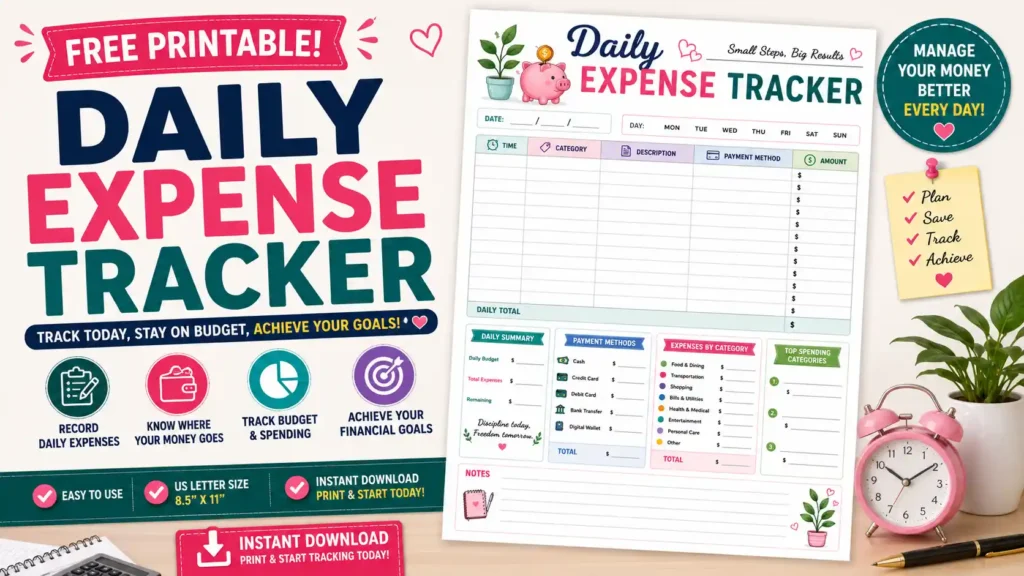
Download Your Free Daily Expense Tracker Printable
Download Your Free Daily Expense Tracker Printable
Stay in control of your daily spending with this free Daily Expense Tracker Printable PDF. Record every purchase, organize expenses by category, monitor your daily budget, track payment methods, and build better money habits with this easy-to-use finance worksheet.
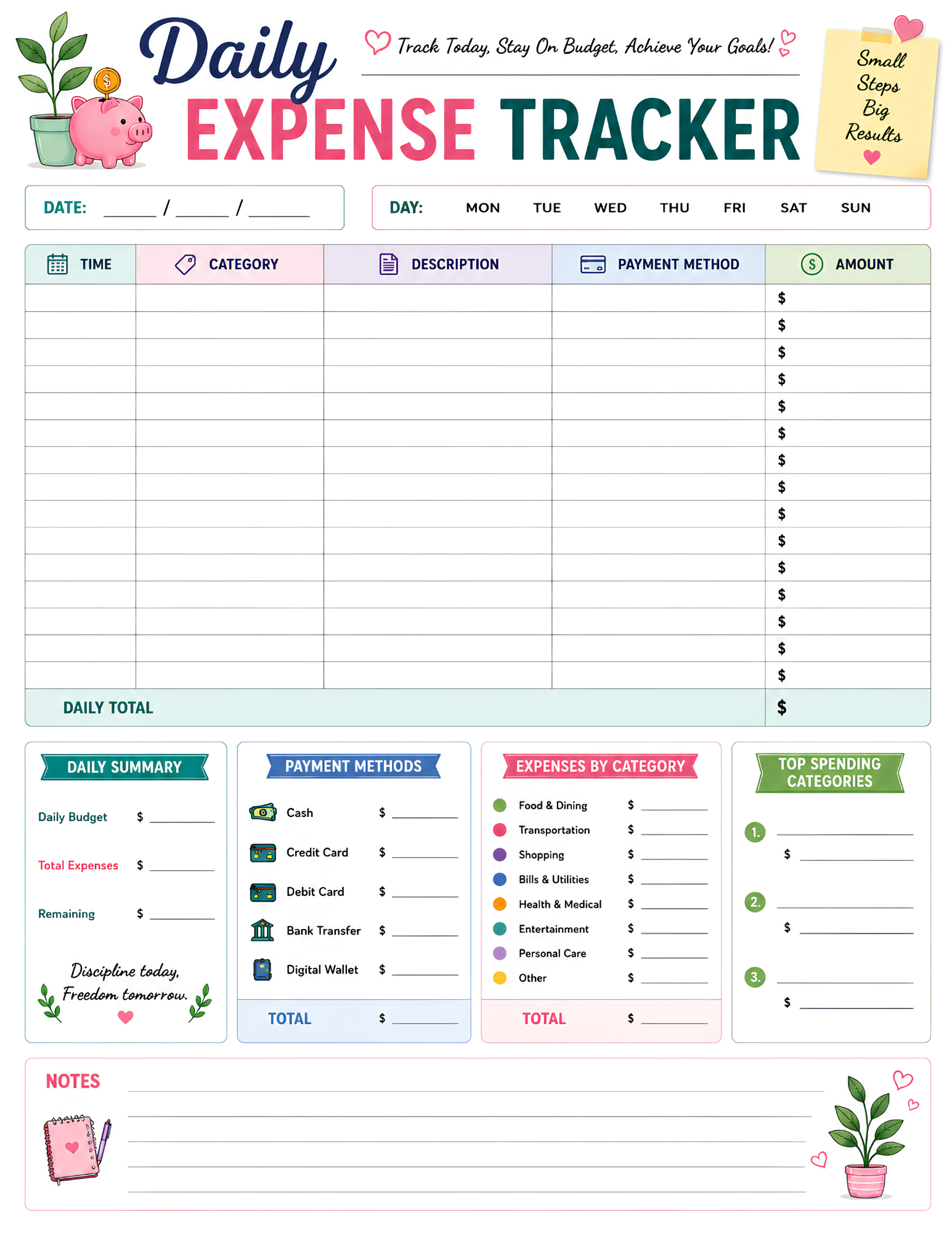
Note: This high-resolution PDF file is 100% free for personal use. Print as many pages as you need to establish a consistent, bulletproof daily expense logging routine.
What Is a Daily Expense Tracker?
A daily expense tracker printable is a structured, hyper-focused ledger designed specifically to capture the micro-transactions that standard monthly worksheets often miss. Think of it as an interactive, real-time daily expense log printable that acts as an early warning system for your personal economy. Rather than letting transactions blur together over a 30-day period, a daily sheet requires you to pause and document your cash flow as it happens, creating an active relationship between your wallet and your long-term goals.
Consistently utilizing a daily spending tracker is vital for long-term budgeting success because it targets human psychology. Most people do not blow their budgets on big, structural items like rent or auto loans; they blow them on small, repetitive luxury items. A random coffee at the drive-thru, a quick mid-day snack, a fast-food lunch run, or an unplanned online checkout might feel completely insignificant in isolation. However, when these minor transactions repeat multiple times a week, they turn into a massive cash drain that can quietly ruin your broad savings targets.
Furthermore, integrating a physical daily budget worksheet into your routine helps you quickly identify unnecessary spending patterns before they damage your financial standing. By reviewing your entries every evening, you create an immediate feedback loop. You move away from reactive panic at the end of the month and move toward active, intentional adjustments. Seeing your cash flow written down in black and white forces you to look at your habits honestly, helping you make smarter choices tomorrow based on real data from today.
What’s Included?
This premium daily finance tracker includes a clean, comprehensive data layout optimized to capture every detail of your daily cash flow:
- Date: A dedicated line to note the calendar day, keeping your historical records filed chronologically.
- Day of the Week: A simple checkbox or line to track spending habits across specific days (e.g., monitoring weekend spending spikes).
- Time: A precise slot to note when the transaction occurred, helping you identify time-based emotional spending triggers.
- Expense Category: A clean label box to group your spending (e.g., Food, Transport, Shopping).
- Description: A clear space to record the specific merchant or item purchased.
- Payment Method: A dedicated area to note whether you used cash, credit, debit, or mobile apps.
- Amount: A structured column to enter the exact dollar figure spent.
- Daily Total: A highlighted mathematical section at the bottom to sum up your complete outgoings for the 24-hour cycle.
- Daily Budget Summary: A baseline comparison space to contrast your actual spending against your ideal daily limit.
- Expenses by Category: A mini data matrix to sort your outlays and identify your top spending categories.
- Payment Method Summary: A quick reference zone to see if you are relying too heavily on plastic or mobile wallets.
- Notes Section: A flexible, open-ended canvas for tracking future bills, documenting irregular expenses, or writing motivational reminders.
- US Letter Size (8.5 × 11″): Native formatting for effortless home printing with crisp lines and clear text margins.
- Instant Download: Immediate, unlimited access to the high-grade PDF file so you can begin tracking today.
How to Use This Daily Expense Tracker
To get the absolute most out of this comprehensive spending tracker printable, build this simple, ten-step routine into your daily schedule.
Step 1: Write the Date and Day
Start each morning by filling out the exact calendar date and day of the week at the very top of your daily expenses worksheet. Keeping this updated ensures your records stay completely organized when you file them in your binder.
Step 2: Set Your Daily Spending Budget
Before you spend a single dollar, write down your target daily limit in the budget summary box. Having a clear limit in mind early in the day gives your brain a boundary to respect as you go about your routine.
Step 3: Record Every Purchase
Every time you complete a transaction—whether you are swiping a card, tapping your phone, or handing over physical cash—log the item immediately on your expense log printable.
- Examples: Morning coffee runs, supermarket groceries, fuel stops, quick lunches, online orders, or public transit fares.
Step 4: Select the Expense Category
Assign your purchase to a specific category line. Keeping your entries grouped consistently makes it incredibly simple to audit your data at the end of the week.
Step 5: Write the Payment Method
Note exactly how the transaction was funded. Documenting this helps you keep your credit card balances transparent and makes reconciling your statements a breeze.
- Examples: Physical cash, Visa/Mastercard credit lines, checking account debit cards, direct bank wire transfers, or digital mobile wallets.
Step 6: Record the Amount Spent
Write down the exact dollar amount listed on your receipt. Do not round numbers down or omit the change; absolute accuracy is key to building real financial awareness.
Step 7: Calculate Your Daily Total
At the end of the evening, pull out a calculator and add up every entry on your sheet. Write the final number clearly in the “Daily Total” box to see exactly what it cost to run your life for the day.
Step 8: Review Your Largest Spending Categories
Look down your category column and highlight the areas where your cash went fastest. Pinpointing these high-velocity categories helps you see exactly where your budget is under the most pressure.
Step 9: Check Your Remaining Daily Budget
Subtract your daily total from your initial spending budget. If you finished the day in the green, celebrate the win! If you overspent, think about what triggered the purchases and use that insight to adjust tomorrow’s plan.
Step 10: Write Notes or Reminders
Use the flexible notes section to log future bill reminders, track cash envelope balances, or write down ideas on how to cut back on discretionary spending tomorrow.
Benefits of Using a Daily Expense Tracker
Using a physical finance printable as part of your daily routine provides strategic financial advantages that go far beyond basic math:
Know Where Your Money Goes
Tracking removes all mystery from your personal finance. Instead of looking at a low bank balance and wondering what happened, you have a physical record detailing exactly where every dollar went.
Reduce Impulse Spending
A physical logging sheet introduces instant behavioral accountability. Knowing that you have to manually record an impulse purchase on paper creates a moment of mindfulness, which naturally helps you pause and curb unnecessary spending.
Stay Within Budget
Daily check-ins stop minor spending leaks from turning into major monthly deficits. By catching overspending within a 24-hour window, you can easily tweak your habits the next day and keep your broad goals completely intact.
Improve Saving Habits
When you consciously reduce small daily leaks, you naturally increase your monthly cash margin. That extra cash can be funneled directly into your high-yield savings goals or emergency funds.
Build Financial Discipline
Consistency is the foundation of wealth building. The simple act of sitting down with your tracker every evening builds the mental focus and self-control required to handle larger financial projects with confidence.
Identify Spending Patterns
Tracking reveals your personal emotional triggers. You will quickly begin to spot trends—like overspending on takeout during stressful workdays or splurging on online shopping out of boredom—allowing you to make proactive changes.
Reach Financial Goals Faster
Whether you are working to eliminate consumer debt, save for a home down payment, or invest for retirement, tracking speeds up your timeline. It ensures your cash is deployed efficiently rather than wasted on forgettable items.
Make Smarter Financial Decisions
Empirical daily data turns budgeting from a guessing game into a clear strategy. You can base your future goals on real, proven spending history rather than vague estimates.
Common Expense Categories
To keep your daily money tracker neat and easy to analyze, group your transactions into these standard categories:
- Food & Dining: Restaurant dinners, fast-food runs, coffee shops, bar tabs, and office vending machines.
- Groceries: Mid-week supermarket stops, pantry restocks, fresh produce, and household cleaning supplies.
- Transportation: Public transit passes, train fares, rideshare apps, tolls, and parking garage fees.
- Fuel: Regular gasoline fill-ups or electric vehicle charging costs.
- Shopping: Clothing, footwear, home decor items, books, and casual retail therapy.
- Bills & Utilities: Daily portions of recurring payments, mobile phone updates, or digital software subscriptions.
- Entertainment: Movie tickets, concert admissions, sporting events, and video game downloads.
- Health & Medical: Pharmacy prescriptions, co-pays, first-aid items, and wellness supplies.
- Personal Care: Hair salon visits, cosmetics, toiletries, and gym supplements.
- Education: Textbook purchases, online courses, school supplies, or certification costs.
- Gifts: Birthday presents, greeting cards, flowers, or voluntary charitable donations.
- Miscellaneous: Quick cash tips, postage stamps, dry cleaning, or unexpected minor fees.
Tips for Tracking Daily Expenses
Simply printing out a worksheet won’t change your finances; real transformation happens when you execute the habit flawlessly. Use these pro strategies to ensure absolute success:
Record Expenses Immediately
Do not wait until the weekend to catch up. Log your purchases immediately after they happen or set a calendar reminder on your phone to fill out your sheet every evening before bed while the details are still fresh.
Save Every Receipt
Always ask for a receipt at checkout or take a quick screenshot of your digital order confirmations. Having a physical paper trail ensures you never have to guess about a missing transaction when updating your records.
Review Your Tracker Each Evening
Treat personal finance like a small business. Spend three minutes every night reviewing your sheet, updating your totals, and checking your progress against your daily budget limit.
Avoid Unnecessary Purchases
Adopt a simple rule for discretionary items: if it isn’t on your plan before you leave the house, don’t buy it. Creating that small barrier helps you save significant amounts of cash over the course of a month.
Set a Daily Spending Limit
Calculate a baseline daily allowance by dividing your discretionary monthly income by 30. Having a clear, day-to-day spending limit makes budgeting feel much more manageable than looking at one large monthly figure.
Use Consistent Categories
Keep your labeling uniform across all your sheets. Using the exact same categories every day makes it incredibly easy to aggregate your data when you transfer it to a monthly tracker.
Compare Daily Spending Every Week
At the end of the week, line up your seven daily sheets side by side. Look for patterns, pinpoint the specific days you tended to overspend, and adjust your weekend strategy accordingly.
Celebrate Days You Stay Under Budget
Acknowledge your discipline! If you hit a zero-spend day or stayed comfortably under your target limit, take a moment to appreciate your focus. Celebrating these small wins keeps burnout completely at bay.
Common Money Mistakes
Protect your financial momentum by identifying and avoiding these common day-to-day tracking traps:
- Ignoring Small Purchases: Disregarding small items like a dollar vending machine snack or a small app purchase will leave a confusing gap in your records at the end of the week.
- Not Tracking Cash Spending: Physical cash is incredibly easy to spend mindlessly. Log cash transactions just as strictly as card purchases to keep your record accurate.
- Forgetting Subscriptions: Overlooking micro-subscriptions that auto-renew on random days can quietly drain your checking account without you realizing it.
- Overspending on Dining Out: Relying constantly on takeout and convenience food because it feels easier can quickly become the single largest budget-killer on your sheet.
- Shopping Without a Budget: Walking into a store without a clear list and a set spending limit guarantees you will walk out with impulse items you don’t actually need.
- Not Reviewing Expenses: Filling out your worksheet but immediately closing it and hiding it in a drawer turns tracking into an empty chore. Always review the data to learn from your habits.
- Depending on Memory Instead of Records: Relying on mental math to track your spending virtually guarantees you will underestimate your actual outgoings by 20% to 30% every single week.
Daily vs. Monthly Expense Tracking
Understanding how short-term daily tracking supports your long-term monthly planning is key to building a comprehensive personal finance strategy.
| Feature | Daily Expense Tracking | Monthly Expense Tracking |
| Data Scope | Records every single individual micro-purchase | Aggregates data to give a broad macro-view |
| Behavioral Impact | Controls immediate spending impulses and builds daily awareness | Analyzes long-term financial trends and seasonal changes |
| Primary Purpose | Perfect for day-to-day habit building and discipline | Designed for high-level financial planning and goal setting |
| Core Advantage | Catches errors and spending leaks within a 24-hour window | Supports broad wealth building and net worth goals |
Who Should Use This Printable?
This highly adaptable daily budget planner is designed to provide massive organization and structure to individuals across all walks of life:
- Students: Perfect for mastering the fundamentals of personal finance early, managing tight weekly allowances, and budgeting for food and books.
- Families: A fantastic resource for tracking shared household variables, managing grocery runs, and controlling day-to-day miscellaneous outlays.
- Couples: Provides an objective, completely transparent framework for couples to discuss discretionary spending habits and stay aligned.
- Freelancers: Essential for managing irregular income streams, tracking daily business outlays, and keeping personal spending transparent.
- Small Business Owners: Great for cataloging minor daily out-of-pocket operational costs before migrating them to formal business accounting software.
- Budget Binder Users: Formatted to fit standard planner systems, serving as the daily tactical hub of your broad household finance binder.
- Anyone Wanting Better Money Management: Whether you are working your way out of consumer debt or managing a high income, this worksheet brings valuable clarity to your daily habits.
Frequently Asked Questions
Is this Daily Expense Tracker free?
Yes. This PDF resource is 100% free to download, print, and use for all personal finance tracking and budgeting purposes.
What paper size is it?
The printable worksheet is professionally formatted to standard US Letter size (8.5 × 11 inches), ensuring a perfect print on standard home machines.
Can I print multiple copies?
Absolutely! You can print out a bundle of 30 pages at the start of the month to build a complete daily logging habit, or print pages as you need them for specific high-spend weeks.
Can I use one every day?
Yes. Using a fresh sheet every day gives you the cleanest view of your habits, but you can also use a single sheet to track an entire weekend if your transaction volume is lower.
Is it beginner friendly?
Yes, it features a highly intuitive layout. You do not need any advanced financial or spreadsheet experience—simply grab a pen, track your purchases honestly, and add up the totals at the end of the day.
Can I laminate it?
Highly recommended! Laminating your sheet allows you to place it on your kitchen counter or desk and use dry-erase markers to update your numbers daily, saving paper and keeping the habit completely friction-free.
Can I use it alongside other finance printables?
Definitely. This daily tracker serves as the tactical foundation that feeds clean, accurate data directly into your broad monthly budget planners, income worksheets, and savings logs.
Related Printables
To build a fully customized, highly effective home management binder, check out these excellent complementary finance printables:
- Income & Expense Tracker Printable
- Monthly Budget Planner Printable
- Weekly Budget Planner Printable
- Annual Budget Planner Printable
- Financial Goals Worksheet Printable
- Monthly Savings Tracker Printable
- Savings Goal Tracker Printable
- Emergency Fund Tracker Printable
- Net Worth Tracker Printable
- Expense Tracker Printable
- Bill Payment Tracker Printable
- Subscription Tracker Printable
- Cash Envelope Tracker Printable
- Sinking Fund Tracker Printable
- Debt Payoff Tracker Printable
- Debt Snowball Tracker Printable
- No Spend Challenge Printable
- 52 Week Savings Challenge Printable
- 100 Envelope Challenge Printable
Final Thoughts
Improving your financial health doesn’t require drastic, sweeping lifestyle transformations; it starts by simply paying closer attention to the small choices you make every day. By using this daily expense tracker printable, you stop playing defense with your money and start playing offense. You actively transition from a state of financial mindlessness to a position of absolute awareness and control. Lay out your daily budget limit, record your purchases accurately as they happen, review your data every evening, and eliminate the hidden leaks draining your wallet. Download your free printable today, stick to the process, and take a confident step toward a debt-free, secure financial future.