
Taking control of your finances often hinges on a simple principle: what gets measured gets managed. If you have ever reached the end of the month wondering why your bank account looks bare despite your best intentions, you are not alone. Building an impactful savings habit requires more than just willpower; it demands clarity, structure, and visual accountability. Using a dedicated monthly savings tracker printable is one of the most effective, low-friction ways to turn your financial goals into real cash reserves.
Whether you are aggressively building a robust emergency fund, setting money aside for a dream vacation, preparing for the holidays, or mapping out a down payment on a house, this premium printable sheet keeps your daily habits aligned with your ultimate goals. Professionally formatted for standard US Letter size (8.5 × 11 inches), this document integrates seamlessly into any standard home budget binder, physical planner, or personal finance journal, giving you a tangible, front-and-center look at your wealth-building journey.
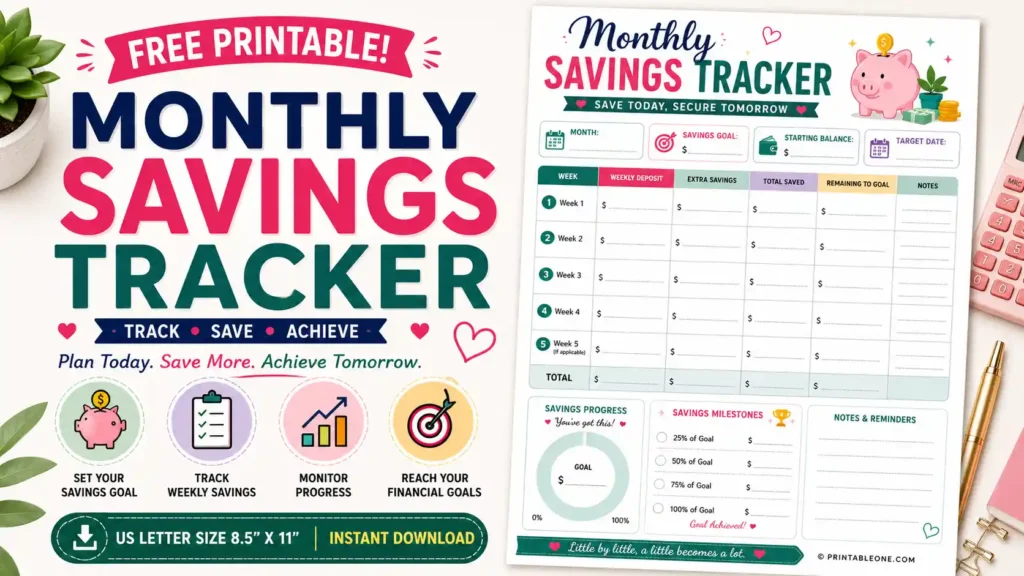
Download Your Free Monthly Savings Tracker Printable
Download Your Free Monthly Savings Tracker Printable
Stay motivated and grow your savings with this free Monthly Savings Tracker Printable PDF. Set a monthly savings goal, record weekly deposits, track extra savings, monitor your progress, celebrate milestones, and achieve your financial goals with this easy-to-use printable worksheet.
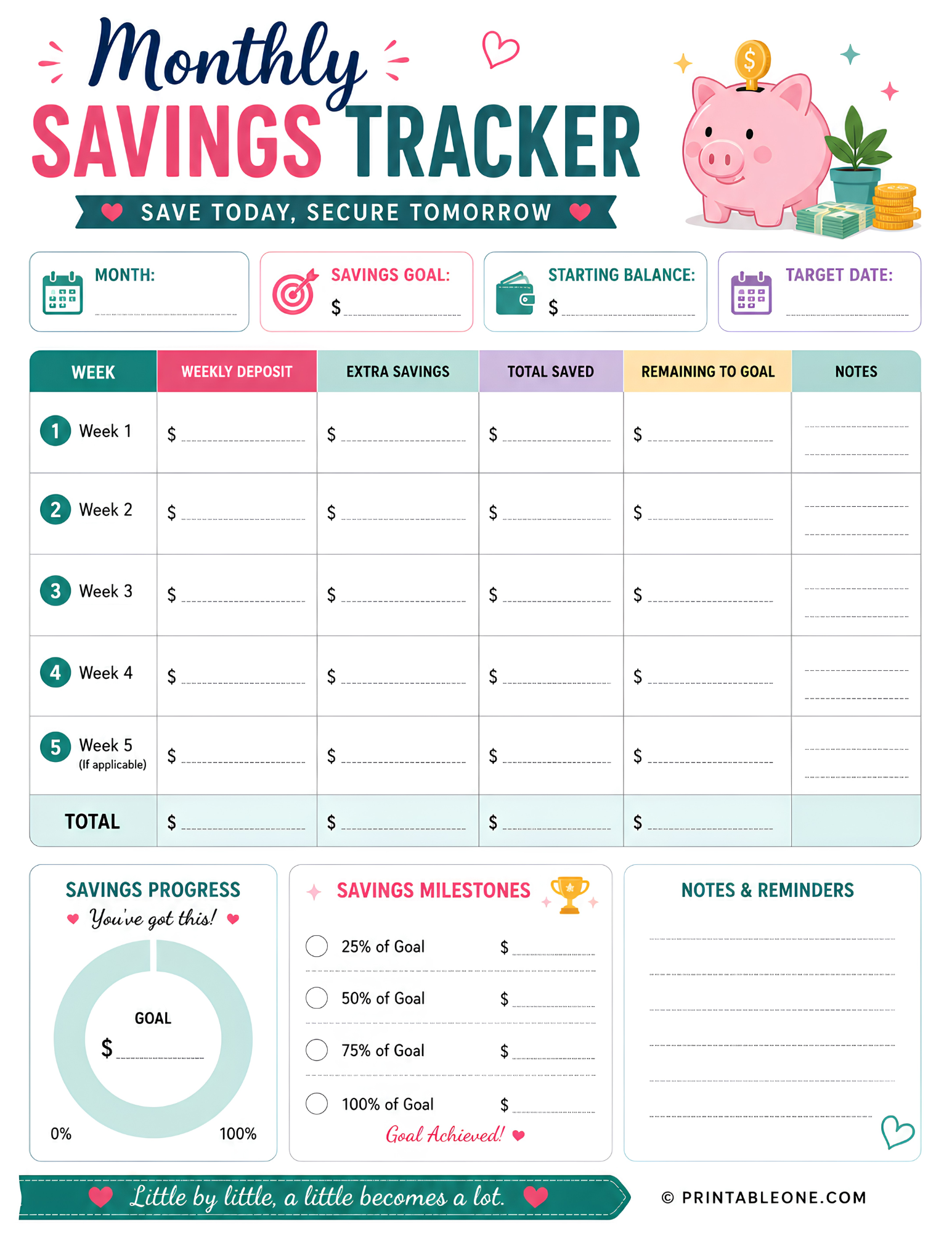
Note: This high-resolution PDF is completely free for personal use. Print as many copies as you need to build a consistent, lifelong saving routine.
What Is a Monthly Savings Tracker?
A monthly savings tracker printable is a targeted, practical financial tool engineered to give you a clear, comprehensive overview of your saving activity over a single four-week cycle. Think of it as a highly focused monthly savings worksheet that bridges the gap between a vague desire to “save more money” and the execution of micro-deposits that make it happen. By taking your eyes off complex spreadsheets and putting a physical sheet on your desk or refrigerator, you convert abstract numbers into an active, engaging daily practice.
Consistently monitoring your funds with a physical savings tracker printable drastically improves your behavioral consistency. In personal finance, out of sight truly means out of mind. When your money goals are hidden behind digital banking apps, it becomes incredibly easy to overspend, assuming you will simply save whatever happens to be left over at the end of the cycle. A physical tracker flips that dynamic entirely. It forces you to prioritize your goals first, creating a psychological feedback loop where every checkbox filled or line item updated acts as a shot of positive reinforcement.
Visual progress is a proven driver of human motivation. Seeing your accumulated balance rise week by week releases dopamine, making the act of saving feel just as rewarding as the act of spending. It helps you build ironclad financial habits by transforming budgeting from a chore rooted in restriction into an empowering game of asset growth. Over time, this shifts your entire relationship with money, teaching your brain to value long-term financial security over fleeting impulse purchases.
What’s Included?
This comprehensive monthly savings planner is designed with features that capture every detail of your monthly cash flow, ensuring you stay hyper-focused and highly organized:
- Month: A clean heading slot to specify the exact month you are tracking, helping you build a historical record over the year.
- Savings Goal: Your ultimate target dollar amount for the 30-day period, establishing a clear target to aim for.
- Starting Balance: The initial amount of money already allocated to this specific bucket at the absolute beginning of the month.
- Target Date: A firm deadline that instills healthy accountability and timeline structure.
- Weekly Deposits: Structured rows to log your core contributions across Week 1, Week 2, Week 3, and Week 4.
- Extra Savings: A dedicated section to capture unexpected financial windfalls like bonuses, gifts, or side hustle revenues.
- Total Saved: A final calculation box displaying the total sum of all money preserved during the month.
- Remaining Goal: The net mathematical gap between your current standing and your final destination.
- Weekly Notes: Space to document specific shifts in your budget, highlight lean weeks, or record variables.
- Savings Progress Circle: A highly visual graphic element you can color in or shade to represent your percent completion.
- Savings Milestones: Specific intermediate thresholds (e.g., 25%, 50%, 75%) to celebrate as you progress toward your target.
- Notes & Reminders: A highly flexible open space for motivational quotes, account numbers, or next month’s strategic tweaks.
- US Letter Size (8.5 × 11″): Formatted cleanly for standard US printing specifications for hassle-free home duplication.
- Instant Download: Immediate access to the high-grade PDF asset so you can print and plan without delay.
How to Use This Monthly Savings Tracker
To maximize the impact of this savings progress tracker, follow this straightforward, step-by-step framework to organize your monthly workflow.
Step 1: Write the Month
Start by writing down the current month at the top of your money saving worksheet. This simple act anchors your focus to the immediate 30 days ahead and helps you keep your physical records filed sequentially.
Step 2: Set Your Monthly Savings Goal
Determine a realistic yet challenging target dollar amount. Avoid choosing an arbitrary number; look closely at your income and expenses, and write down a figure that pushes you to minimize waste without completely starving your lifestyle.
Step 3: Record Your Starting Balance
Note down exactly how much cash is sitting in your designated savings account on day one. If you are starting completely fresh with a brand-new financial target, proudly write down $0.
Step 4: Add Your Target Completion Date
Establish a firm deadline for when this specific monthly sprint concludes. Typically, this will be the final calendar day of the month or your last paycheck date of the cycle.
Step 5: Track Every Weekly Deposit
Every single time you move money from your primary checking account into your savings vehicle—whether it’s on payday or at the end of the week—log the exact amount on your printable savings log.
Step 6: Record Extra Savings
Life is full of small financial wins. Whenever you score unexpected cash, write it down immediately in the extra savings column to track how micro-wins accelerate your timeline.
- Examples: Credit card cashback rewards, an unexpected corporate bonus, birthday gift money, or profit generated from a weekend side hustle.
Step 7: Calculate Total Saved
At the close of the month, add up all your weekly regular deposits and your extra savings entries. Write this final figure down as your total saved for the month.
Step 8: Update the Remaining Balance
Subtract your total saved from your initial savings goal. If you hit or exceed the number, celebrate! If you fell slightly short, look at the gap objectively without self-judgment and carry the momentum forward into the next calendar period.
Step 9: Mark Savings Milestones
As you hit intermediate points throughout the month, shade or color in your savings goal tracker progress circle. This visual tracking reinforces your positive behavioral changes.
Step 10: Review Your Progress at the End of the Month
Sit down for ten minutes at the end of the month to evaluate your results. Look closely at what worked well, figure out what tripped up your budget, and use those insights to set an even smarter goal for the upcoming month.
Benefits of Using a Monthly Savings Tracker
Integrating a high-quality finance printable into your daily routine provides strategic financial advantages that go far beyond just putting pen to paper.
Build Better Saving Habits
Habits are built through consistent, repeated actions. By forcing yourself to interact with your savings data weekly, you systematically train your brain to prioritize asset preservation over immediate consumption.
Stay Motivated
When you are sacrificing small luxuries to build a better future, it is easy to lose your momentum. A physical tracker serves as a visual testament to your hard work, constantly reminding you exactly why the sacrifice is worth it.
Reach Financial Goals Faster
When you actively track a metric, your performance naturally improves. By focusing on your savings target throughout the month, you instinctively spot opportunities to save more, helping you hit your milestones ahead of schedule.
Visualize Your Progress
Numbers on a digital banking screen can often feel abstract and detached from reality. Coloring in a physical progress tracker makes your growth real, helping you visualize your financial security building in real time.
Improve Money Management
You cannot optimize what you do not track. Using a dedicated monthly money tracker forces you to examine your cash flow regularly, exposing inefficiencies and giving you total command over your net worth.
Stay Consistent
It is easy to save money enthusiastically during the first week of January or right after a raise, but consistency tends to fade over time. A monthly tracking cadence provides the ongoing structure required to maintain that momentum all year long.
Reduce Overspending
When you are highly conscious of your weekly savings targets, your impulse spending naturally drops. You will find yourself pausing before buying unneeded items, realizing that spending that cash directly delays filling up your tracker.
Celebrate Savings Milestones
A tracking sheet provides natural inflection points to celebrate your hard work. Hitting your 50% or 100% mark gives you a structured reason to acknowledge your discipline, which keeps financial burnout at bay.
What Can You Save For?
A versatile personal finance printable can be customized to track almost any financial milestone. If you need inspiration, here are some common short- and long-term targets:
- Emergency Fund: Building a three-to-six-month cash cushion to cover unexpected job losses, car break-downs, or urgent medical expenses completely debt-free.
- Vacation: Allocating cash weekly for flights, lodging, and dining so you can enjoy your next getaway without worrying about a lingering credit card balance.
- Holiday Gifts: Setting aside small amounts of cash early in the year to completely avoid the classic financial stress of December shopping.
- New Car: Amassing a sizeable down payment or saving up to buy a reliable vehicle outright to keep your monthly payments minimal.
- Home Down Payment: Accumulating the necessary capital to secure a mortgage, cover closing costs, and move into your dream home.
- College: Building a dedicated fund for future tuition fees, textbooks, or housing costs for your kids or your own continuing education.
- Wedding: Structuring your savings early to pay for venues, photography, and catering without starting your marriage in debt.
- Business: Setting aside seed money to launch a side hustle, purchase inventory, or invest in tools and software for your small business.
- Retirement: Supplementing your long-term investment accounts by saving cash to maximize your annual IRA or 401(k) contributions.
- New Electronics: Saving intentionally for a new laptop, phone, or camera instead of relying on high-interest store financing plans.
- Medical Expenses: Building a safety net to manage high deductibles, dental procedures, or unexpected health insurance co-pays comfortably.
- Home Renovation: Funding kitchen updates, landscaping projects, or necessary roof repairs entirely with cash.
Tips to Save More Every Month
If you want to maximize your tracking sheets and supercharge your savings rate, build these highly effective personal finance strategies into your routine:
Pay Yourself First
Do not save what is left over after spending; instead, spend what is left over after saving. The moment your paycheck hits your account, immediately transfer your target savings amount out of sight before you pay bills or buy groceries.
Automate Savings
Take human error and willpower out of the loop entirely. Set up recurring transfers through your bank to automatically move cash into your savings account on payday.
Reduce Impulse Purchases
Adopt the 24-hour rule. Whenever you feel the urge to buy a non-essential item, force yourself to wait a full day. More often than not, the emotional urge will fade, and you can slide that saved cash straight into your tracker.
Track Every Deposit
No deposit is too small to count. Whether it is a $500 transfer from your primary paycheck or a $5 bill you saved by making coffee at home, write it down. Every single entry builds positive momentum.
Use Cash Envelopes
If you struggle with swiping plastic, switch to a cash envelope system for your variable spending categories like dining out or clothing. When the physical cash in the envelope is gone, your spending stops for the month.
Cut Unnecessary Subscriptions
Audit your bank statements once a quarter to find zombie subscriptions. Cancel streaming platforms, apps, or gym memberships you haven’t used in the past 30 days and redirect those funds straight to your goals.
Review Your Budget Weekly
Do not wait until the final day of the month to check your status. Spend five minutes every Sunday looking over your transactions, checking your progress, and adjusting your spending plan for the week ahead.
Celebrate Small Milestones
Give yourself credit for your discipline. When you hit a quarter or half of your goal, celebrate with a low-cost reward like a movie night or a favorite home-cooked meal. Acknowledging your wins keeps you motivated for the long haul.
Common Saving Mistakes
Keep an eye out for these classic saving traps to make sure your tracking efforts yield the absolute best results:
- Not Setting a Goal: Saving without a clear target is like driving without a destination. Without a specific number to shoot for, your motivation will naturally drop when temptations pop up.
- Skipping Weekly Tracking: Waiting until the very end of the month to fill out your sheet makes it easy to forget small deposits or overlook minor overspending until it is too late to fix it.
- Saving Inconsistently: Depositing huge sums one month and absolutely nothing the next prevents you from building a sustainable habit. Aim for steady, predictable contributions over big, erratic spikes.
- Ignoring Small Expenses: Daily $5 luxury coffees or small impulse buys might seem harmless, but they quickly add up over 30 days, quietly draining money that could be building your emergency fund.
- Using Savings for Non-Emergencies: Raiding your dedicated savings account to fund casual shopping trips or spontaneous dinners completely defeats the purpose of your tracker. Keep your savings secure and separate.
- Not Reviewing Progress: Tucking your sheet away deep inside a desk drawer ensures it will be forgotten. Keep it somewhere highly visible to maintain daily focus.
- Giving Up Too Early: Having a high-expense month or hitting a financial roadblock isn’t a sign of failure. Do not throw your hands up and quit; simply turn the page, print out a fresh sheet, and reset your goals for the next month.
Monthly Savings vs. Yearly Savings
Understanding the relationship between short-term micro-habits and long-term macro-planning is essential for building a truly well-rounded personal finance strategy.
| Feature | Monthly Savings | Yearly Savings |
| Primary Management | Incredibly easy to handle and adjust | Requires high-level, strategic planning |
| Tracking Velocity | Offers fast feedback and quick pivots | Provides a comprehensive, big-picture overview |
| Habit Formation | Builds immediate, daily discipline | Measures long-term financial growth and trajectory |
| Ideal User Profile | Perfect for beginners and short sprints | Designed for major life goals and investments |
Who Should Use This Printable?
This highly adaptable savings planner PDF is designed to provide massive organization and value to individuals at any stage of their financial journey:
- Students: An ideal tool for mastering the basics of cash flow early, saving for textbooks, or preparing for post-graduation expenses.
- Families: A fantastic resource for aligning household priorities, saving up for family vacations, and ensuring your home safety net is rock solid.
- Couples: Provides a clear, transparent framework for couples to sit down, talk about their future dreams together, and manage their joint goals smoothly.
- Freelancers: Essential for building cash reserves to balance out fluctuating monthly incomes and setting aside money for quarterly taxes.
- Small Business Owners: Great for tracking personal capital contributions, saving for future equipment updates, or maintaining a reliable cash buffer.
- Budget Binder Users: Tailored to fit cleanly into standard planner systems, acting as a highly visual hub for your monthly savings strategy.
- Anyone Wanting to Save More Money: Whether you are working through debt or managing a high income, this worksheet brings valuable clarity and purpose to your cash flow.
Frequently Asked Questions
Is this Monthly Savings Tracker free?
Yes. This downloadable resource is 100% free to print and use for all personal budgeting and financial planning purposes.
What paper size is it?
The document is professionally designed at standard US Letter size (8.5 × 11 inches), ensuring a perfect print on standard home machines.
Can I print multiple copies?
Absolutely! You can print out twelve copies at the beginning of the year to map out your entire year, or use different sheets simultaneously to track completely separate savings goals.
Can I laminate it?
Laminating your sheet is a fantastic idea. It allows you to use dry-erase markers to easily update your balances and color in your progress circle month after month without having to print a new page.
Should I use one every month?
Yes. Printing out a fresh sheet every month lets you easily track your progress over time, giving you a clear look at how your habits improve from month to month.
Is it beginner friendly?
Yes, it features a highly intuitive layout. You do not need any advanced financial experience to use it—simply grab a pen and a calculator, fill in the blanks, and update your numbers weekly.
Can I use it alongside other finance printables?
Definitely. This sheet is designed to work perfectly alongside your existing budget planners, expense logs, cash envelope systems, and long-term financial goals worksheets.
Related Printables
To build a fully customized, highly effective home management binder, check out these excellent complementary finance printables:
- Financial Goals Worksheet Printable
- Annual Budget Planner Printable
- Monthly Budget Planner Printable
- Weekly Budget Planner Printable
- Paycheck Budget Planner Printable
- Savings Goal Tracker Printable
- Emergency Fund Tracker Printable
- Net Worth Tracker Printable
- Expense Tracker Printable
- Bill Payment Tracker Printable
- Subscription Tracker Printable
- Cash Envelope Tracker Printable
- Sinking Fund Tracker Printable
- Debt Payoff Tracker Printable
- Debt Snowball Tracker Printable
- No Spend Challenge Printable
- 52 Week Savings Challenge Printable
- 100 Envelope Challenge Printable
Final Thoughts
Saving money becomes infinitely easier when you drop the guesswork and pick up a clear, structured plan. By using this monthly savings tracker printable, you stop wondering where your money went and start telling it exactly where to go. You transition from passively hoping you can save to actively building your financial security, one week at a time. Put your goals on paper, track your weekly contributions closely, celebrate your wins, and watch your balances grow. Download your free printable today, stick to the process, and take a confident step toward a debt-free, secure financial future.