
Taking control of your money can feel overwhelming, but building a secure financial future becomes entirely manageable when you break it down into clear, actionable steps. If you want to stop wondering where your money went each month and start directing it with intention, using a comprehensive financial goals worksheet printable is the perfect place to start. This free resource is designed to help you organize your short-term, medium-term, and long-term financial milestones while providing a practical, visual framework to achieve them.
Whether you are focusing on building a rock-solid emergency fund, paying off high-interest credit card debt, saving for a down payment on your first home, or planning for a comfortable retirement, this printable worksheet keeps your objectives front and center. Tailored specifically for the standard US Letter size (8.5 × 11 inches), it fits flawlessly into your favorite budget binder, home management notebook, or personal finance journal.
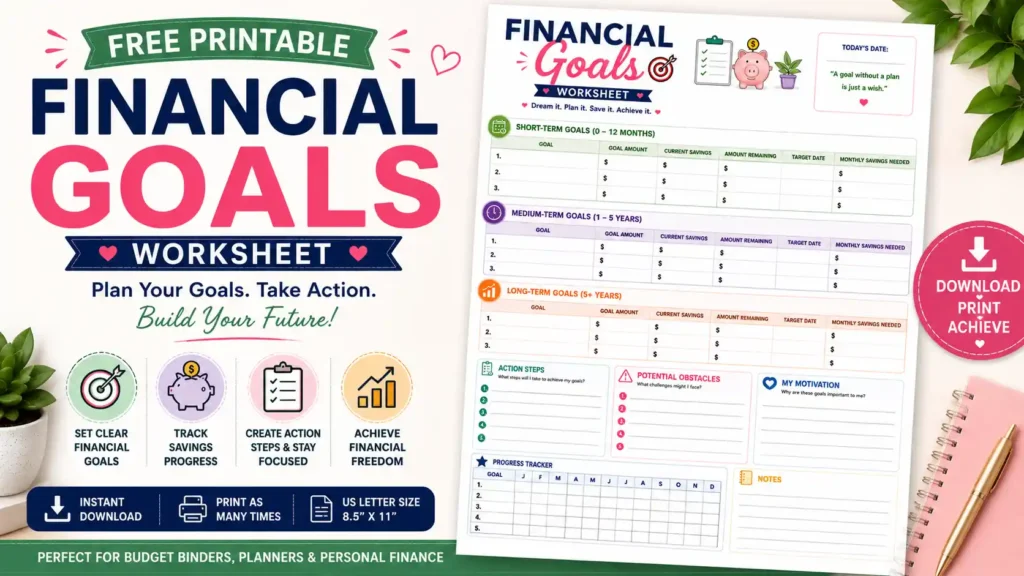
Download Your Free Financial Goals Worksheet Printable
Download Your Free Financial Goals Worksheet Printable
Turn your dreams into achievable milestones with this free Financial Goals Worksheet Printable PDF. Set short-term, medium-term, and long-term financial goals, track your savings progress, create action steps, overcome obstacles, and stay motivated with this easy-to-use printable worksheet.
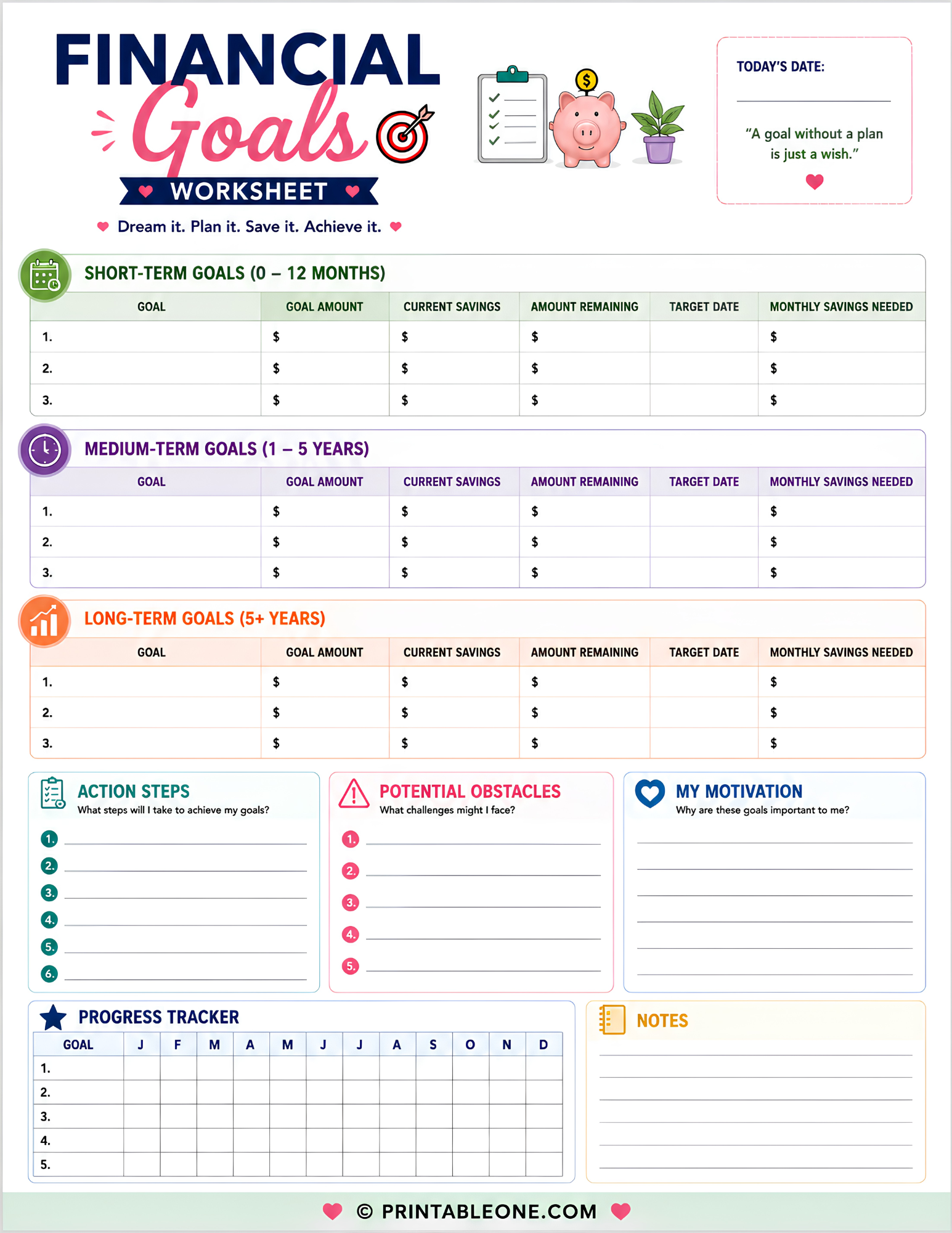
Note: This printable is completely free for personal use. Print as many copies as you need to map out your journey toward financial freedom!
What Is a Financial Goals Worksheet?
A financial goals worksheet printable is a structured, visual tool designed to bridge the gap between your abstract financial dreams and a concrete, actionable plan. Think of it as a customizable financial roadmap worksheet that takes your big-picture aspirations—like buying a home or retiring early—and breaks them down into monthly, manageable savings milestones.
Setting vague resolutions like “I want to save more money this year” rarely works because it lacks specificity and accountability. By utilizing a dedicated financial goal planner, you convert ambiguous wishes into explicit, measurable targets. Research consistently shows that individuals who write down their goals are significantly more likely to achieve them than those who keep them stored in their heads. Writing down your targets creates a psychological commitment, transforming a passing thought into a concrete objective.
Moreover, a physical money goals worksheet serves as a daily or monthly visual touchpoint. Life moves fast, and it is incredibly easy to lose sight of your long-term wealth-building aspirations when faced with daily temptations or impulse spending. Reviewing your progress regularly keeps your mindset aligned with your ultimate priorities. It allows you to track incremental growth, celebrate minor victories, and make swift adjustments to your budget when unexpected expenses arise.
What’s Included?
This premium printable financial planner is packed with comprehensive features to ensure no detail of your financial journey is overlooked. Here is a breakdown of what you will find inside this resource:
- Today’s Date: Establishes your exact timeline starting point to measure your progress accurately over time.
- Short-Term Goals (0–12 Months): Dedicated space for immediate financial priorities that require quick action.
- Medium-Term Goals (1–5 Years): Sections designed for intermediate objectives that require sustained savings over a few years.
- Long-Term Goals (5+ Years): A big-picture space for your major life milestones and long-range wealth accumulation.
- Goal Amount: The exact, total dollar figure required to successfully achieve each individual objective.
- Current Savings: A realistic assessment of the money you have already set aside for this specific target.
- Amount Remaining: The net financial gap between your current standing and your final destination.
- Target Date: A firm deadline that establishes a sense of healthy urgency and structural accountability.
- Monthly Savings Needed: The precise monthly breakdown required to hit your deadline without straining your budget.
- Action Steps: A concrete, step-by-step micro-plan outlining exactly how you intend to generate or save the cash.
- Potential Obstacles: Anticipate potential roadblocks—like irregular expenses or lifestyle creep—before they disrupt your momentum.
- Motivation Section: Your deeply personal “why”—the core emotional reason driving you to achieve this financial milestone.
- Progress Tracker: Visual check-ins or milestones that allow you to mark off your progress along the way.
- Notes: A flexible, open space for recording thoughts, tracking interest rates, or listing bank account details.
- US Letter Size (8.5 × 11″): Optimized for standard printing dimensions, making it incredibly easy to print at home or work.
- Instant Download: Zero waiting periods; download the high-quality PDF file immediately and start planning today.
How to Use This Financial Goals Worksheet
To extract the maximum value from your goal setting worksheet, follow this comprehensive, twelve-step guide to thoroughly map out your financial trajectory.
Step 1: Write Today’s Date
Begin by filling out the date at the very top of your personal finance worksheet. This grounds your financial plan in the present moment and establishes a clear baseline from which you can look back and measure your future growth.
Step 2: List Your Short-Term Financial Goals
Focus on immediate objectives that you want to accomplish within the next year. These are the building blocks of your day-to-day financial security.
- Examples: Building a starter emergency fund ($1,000 to $3,000), saving for an upcoming summer vacation, purchasing a new laptop for work, or caching cash ahead of time for holiday gifts.
Step 3: Write Medium-Term Goals
Shift your focus to milestones that sit comfortably within a one-to-five-year window. These goals require regular, disciplined contributions over a prolonged period.
- Examples: Saving for a reliable used vehicle, financing a wedding, accumulating a down payment for a home, or paying for professional certifications.
Step 4: List Long-Term Goals
Think big picture. Long-term goals generally span five years or more and form the foundation of your generational wealth and ultimate financial peace of mind.
- Examples: Maximizing your retirement accounts (401k, Roth IRA), building a robust brokerage investment portfolio, aggressive mortgage payoff strategies, or achieving complete financial independence.
Step 5: Write Each Goal Amount
Be brutally honest and highly specific. Do not guess or estimate wildly. Research the exact costs associated with your targets and write the precise dollar figure down on your finance planner printable.
Step 6: Record Current Savings
Audit your existing bank accounts, sinking funds, or investment balances. Note down every dollar you have already set aside for these specific goals. If you are starting from zero, that is perfectly fine—write down $0 with confidence, knowing it is the lowest point you will ever be at.
Step 7: Calculate the Remaining Amount
Subtract your current savings from your total goal amount. The resulting number represents the exact target you need to accumulate moving forward.
Step 8: Set a Target Completion Date
Assign a realistic calendar month and year to each goal. Avoid vague phrases like “sometime next year.” A definitive deadline transforms a passive wish into an urgent, actionable project.
Step 9: Calculate Monthly Savings Required
Take the remaining amount calculated in Step 7 and divide it by the number of months left until your target completion date. This gives you a clear monthly savings target.
Step 10: Create Action Steps
Detail exactly how you will execute this plan. Will you cut back on dining out by $50 a week? Will you pick up a weekend side hustle? Will you automate your transfers on payday? Write down these concrete steps.
Step 11: Identify Possible Obstacles
Predict what could go wrong. Identifying hurdles ahead of time—like seasonal utility spikes or car maintenance—allows you to proactively adjust your budget planning worksheet without derailing your primary goals.
Step 12: Review Your Worksheet Every Month
A financial plan is a living document. Sit down with your printed worksheet at the end of every single month to update your progress, adjust timelines if necessary, and keep your focus locked in.
Benefits of Using a Financial Goals Worksheet
Integrating a high-quality financial success planner into your monthly routine offers profound advantages that extend far beyond simply moving numbers around on a page.
Stay Motivated
It is easy to lose steam when you are working hard and sacrificing immediate gratification. Seeing your progress tracker fill up over time provides a powerful psychological boost, reminding you that your hard work is actively paying off.
Build Better Money Habits
When you track your goals visually, your relationship with money shifts. You naturally begin to question impulsive purchases because you can immediately see how spending $100 on a whim delays your dream vacation or home purchase.
Prioritize Financial Goals
You cannot chase ten major goals simultaneously without diluting your focus. A printable goal planner forces you to rank your priorities, allowing you to pour your financial resources into the targets that matter most to you right now.
Increase Savings
By treating your savings targets as mandatory monthly bills rather than an afterthought, you systematically increase the amount of money you retain. You move from saving “whatever is left over” to saving intentionally.
Reduce Financial Stress
Anxiety thrives in ambiguity. When you lay out your numbers clearly, the fear of the unknown dissolves. Even if you have a mountain of debt to climb, having a written plan provides immense peace of mind.
Improve Budget Planning
Your goals directly inform your monthly budget. Instead of building an arbitrary budget, your savings goals worksheet tells your money exactly where to go to maximize efficiency.
Stay Focused
In a world dominated by social media comparison and constant advertisements, it is easy to succumb to lifestyle inflation. A personalized worksheet keeps you anchored to your values, not someone else’s highlight reel.
Monitor Progress Throughout the Year
A worksheet allows you to track patterns over the long haul. You can easily pinpoint which months were highly successful and which months required adjustments, letting you optimize your finances year after year.
Examples of Financial Goals
If you are unsure where to start when filling out your printable, consider these common financial milestones across various stages of life:
- Emergency Fund: Accumulating three to six months of essential living expenses in a high-yield savings account to protect against job losses or medical emergencies.
- Vacation Savings: Setting aside dedicated cash for flights, hotels, and excursions so you can travel completely debt-free.
- Home Down Payment: Saving the traditional 10% to 20% down payment required to secure a competitive mortgage on a house.
- New Vehicle: Building a fund to purchase a reliable car outright or secure a substantial down payment to minimize auto loan interest.
- Wedding Fund: Budgeting intentionally for venues, catering, and attire to ensure your big day does not result in years of financial hangover.
- College Education: Contributing consistently to a 529 plan or specialized savings account to fund your children’s or your own higher education.
- Debt Payoff: Aggressively wiping out student loans, credit cards, or personal loans using proven methods like the Debt Snowball or Debt Avalanche.
- Investment Portfolio: Building long-term wealth by routinely purchasing index funds, ETFs, or real estate assets.
- Business Startup: Amassing capital to launch your own business venture, cover initial overhead, or invest in inventory.
- Retirement: Consistently allocating funds toward 401ks, IRAs, or real estate to ensure complete peace of mind in your golden years.
Tips for Achieving Financial Goals
Simply writing down your goals is an incredible first step, but execution is what turns those dreams into reality. Use these pro strategies to ensure you cross the finish line:
Set SMART Goals
Ensure every single item on your worksheet is Specific, Measurable, Achievable, Relevant, and Time-bound. Instead of writing “Save for a house,” write “Save $24,000 for a down payment by December 2028.”
Break Large Goals Into Smaller Milestones
Looking at a $50,000 debt payoff goal can feel completely paralyzing. Break that massive target into bite-sized milestones, like paying off $4,166 over the next 12 months, or roughly $138 a day. Small wins build unstoppable momentum.
Save Automatically
Remove human error and willpower from the equation. Set up automatic transfers through your online banking portal to move money to your dedicated savings or investment accounts the exact morning your paycheck hits.
Review Your Progress Monthly
Schedule a recurring “Money Date” with yourself or your partner. Grab a coffee, pull out your worksheet, look at the numbers, and update your trackers. Consistency is the secret sauce of personal finance.
Reduce Unnecessary Spending
Audit your bank statements quarterly. Cancel subscriptions you no longer use, cook more meals at home, negotiate recurring bills, and redirect those salvaged funds straight into your primary goals.
Celebrate Small Wins
When you hit 25%, 50%, or 75% of your goal, celebrate it! You don’t need to blow your budget to do so—enjoy a nice home-cooked meal, treat yourself to a movie night, or take a relaxing day off. Acknowledging your progress keeps burnout at bay.
Track Your Savings Consistently
Keep a running tally of your balances. Watching your numbers climb month after month provides a profound psychological reward that reinforces your positive financial habits.
Adjust Goals as Your Situation Changes
Life throws curveballs. You might face an unexpected medical bill, a sudden job change, or a joyous family addition. Do not throw your hands up and quit if things change; simply print out a fresh worksheet, pivot your strategies, and keep moving forward.
Common Goal-Setting Mistakes
Avoid these frequent pitfalls to keep your financial journey smooth and highly successful:
- Setting Unrealistic Goals: Trying to save 70% of your income right out of the gate often leads to extreme deprivation and eventual burnout. Start small and scale up sustainably.
- Not Writing Goals Down: Relying purely on memory ensures that your goals will quickly get buried under the chaotic demands of everyday life. Keep them visible on paper.
- Ignoring Deadlines: Without a target date, there is no psychological urgency. You will naturally postpone saving, assuming you will just “make up for it next month.”
- Not Tracking Progress: If you fail to measure your growth, you will never truly know if your current budget is working effectively or if you need to adjust your trajectory.
- Trying to Achieve Too Many Goals at Once: Spreading your financial resources across fifteen different goals simultaneously means making sluggish progress on all of them. Pick a few core priorities and attack them with maximum focus.
- Not Reviewing Goals Regularly: Tucking your worksheet away deep inside a desk drawer ensures it will be forgotten. Keep it somewhere highly visible, like on your fridge or inside your primary daily planner.
- Giving Up After Setbacks: An unexpected expense is not a sign of failure; it is just a routine part of life. Use your emergency fund, reset your timeline, and resume your plan without guilt.
Short-Term vs. Long-Term Financial Goals
Understanding the distinct differences between various financial horizons helps you allocate your cash efficiently to the appropriate types of bank or investment accounts.
| Goal Horizon | Timeline | Primary Focus | Practical Examples |
| Short-Term | 0 to 12 Months | Liquidity, Safety, Security | Starter Emergency Fund, Holiday Savings, Upcoming Vacation, Small Electronics |
| Medium-Term | 1 to 5 Years | Steady Growth, Balanced Risk | Down Payment for a Home, Buying a Vehicle, Wedding, Career Transitions |
| Long-Term | 5+ Years | Wealth Compounding, Preservation | Retirement Accounts, Financial Independence, Aggressive Mortgage Payoff, Brokerage Portfolios |
Who Should Use This Printable?
This versatile wealth building worksheet is intentionally designed to add immense value to individuals across all walks of life:
- Students: Perfect for learning the fundamentals of personal finance early, budgeting for textbooks, or aggressively paying down student loans before graduation.
- Families: An excellent tool for aligning household priorities, saving for family vacations, planning kids’ extracurricular activities, and building reliable safety nets.
- Couples: Provides a neutral, highly organized framework for couples to sit down together, discuss their future dreams openly, and get on the exact same page financially.
- Freelancers: Essential for managing irregular income streams, calculating quarterly tax allocations, and maintaining business runway during slower months.
- Small Business Owners: Great for separating personal goals from business revenues and budgeting for future capital investments or equipment upgrades.
- Budget Binder Users: Perfectly formatted to slide cleanly into any standard three-ring binder, serving as the strategic crown jewel of your home financial tracking system.
- Anyone Wanting Better Financial Planning: Whether you are completely broke or making a high six-figure income, this worksheet injects absolute clarity into your relationship with money.
Frequently Asked Questions
Is this Financial Goals Worksheet free?
Yes. This PDF resource is 100% free to download, print, and use for personal finance planning.
What paper size is it?
The worksheet is professionally formatted to standard US Letter size (8.5 × 11 inches), ensuring perfect compatibility with standard home printers.
Can I print multiple copies?
Absolutely! You can print fresh copies every single year, or use separate sheets to track distinct categories of goals (e.g., one sheet for family goals and another for your business milestones).
Can I laminate it?
Highly recommended! Laminating your worksheet allows you to use dry-erase markers to constantly update your current savings balances and progress trackers month after month without re-printing.
Should I update it every month?
Yes. Integrating this worksheet into your regular monthly budget routine ensures you stay highly accountable, motivated, and responsive to any changes in your income or expenses.
Is it beginner friendly?
Yes, it features an intuitive layout. You do not need an advanced degree in finance to fill it out—just grab a calculator, fill in the blanks honestly, and follow the simple steps.
Can I use it alongside other finance printables?
Definitely. This worksheet serves as a brilliant high-level roadmap that pairs perfectly with your daily expense trackers, cash envelope printables, and weekly budget logs.
Related Printables
To build an all-encompassing, highly effective home management binder, check out these excellent complementary finance printables:
- Annual Budget Planner Printable
- Monthly Budget Planner Printable
- Weekly Budget Planner Printable
- Paycheck Budget Planner Printable
- Net Worth Tracker Printable
- Savings Goal Tracker Printable
- Emergency Fund Tracker Printable
- Subscription Tracker Printable
- Expense Tracker Printable
- Bill Payment Tracker Printable
- Cash Envelope Tracker Printable
- Sinking Fund Tracker Printable
- Debt Payoff Tracker Printable
- Debt Snowball Tracker Printable
- No Spend Challenge Printable
- 52 Week Savings Challenge Printable
- 100 Envelope Challenge Printable
Final Thoughts
Setting clear financial goals gives every single dollar you earn a distinct, powerful purpose. By utilizing this financial goals worksheet printable, you stop playing defense with your money and start playing offense. You actively transition from a state of financial stress to a state of absolute control. Organize your priorities, calculate your milestones, stay deeply connected to your motivation, and consistently track your progress. Download your free printable today, take charge of your financial narrative, and start transforming your dreams into real financial security.