
Managing your finances over an entire year is easier when you have a clear overview of your monthly spending. While daily and weekly tracking tools are fantastic for controlling your immediate, short-term variable spending, they don’t always capture the macro-level patterns that shape your long-term wealth building. If you want to successfully manage your personal economy and see exactly where your hard-earned money goes over a 12-month period, integrating a comprehensive yearly expense tracker printable into your routine is the ultimate solution. This pro-level spreadsheet alternative allows you to record expenses each month, compare your budget with actual spending, monitor annual totals, and identify areas where you can save more money.
Whether you’re planning a household budget, tracking business expenses, optimizing a freelance cash flow, or working toward long-term financial goals, this printable gives you a complete picture of your finances throughout the year. Designed explicitly in standard US Letter (8.5 × 11 inches) size, it’s perfect for budget binders, planners, and personal finance journals. Keep this high-level document at the very front of your financial planner to keep your structural expenses, recurring obligations, and wealth-building targets aligned all year long.
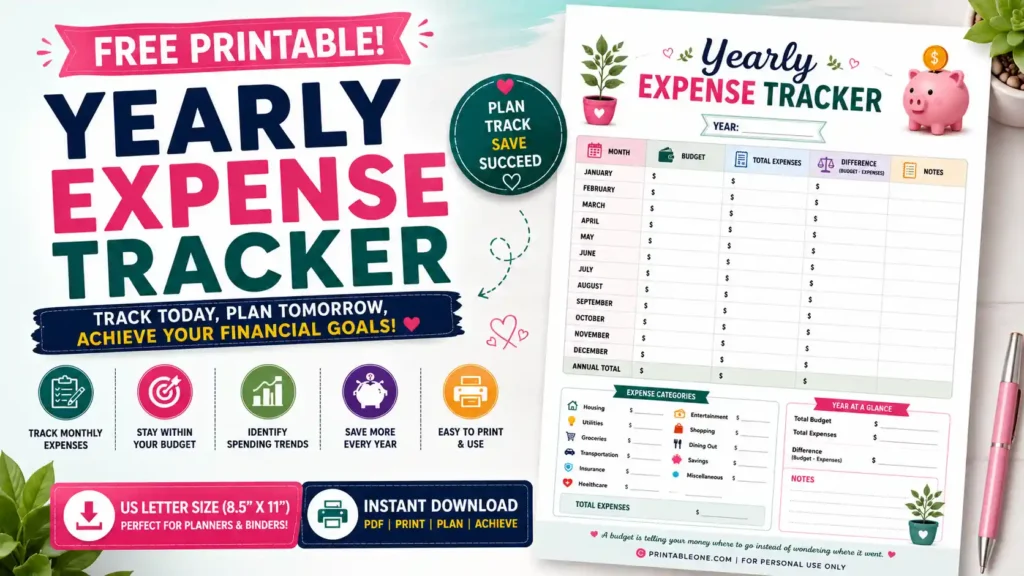
Download Your Free Yearly Expense Tracker Printable
Download Your Free Yearly Expense Tracker Printable
Take control of your finances with this free Yearly Expense Tracker Printable PDF. Track your monthly expenses, compare your budget with actual spending, monitor yearly totals, and gain a clear overview of your finances all year long.
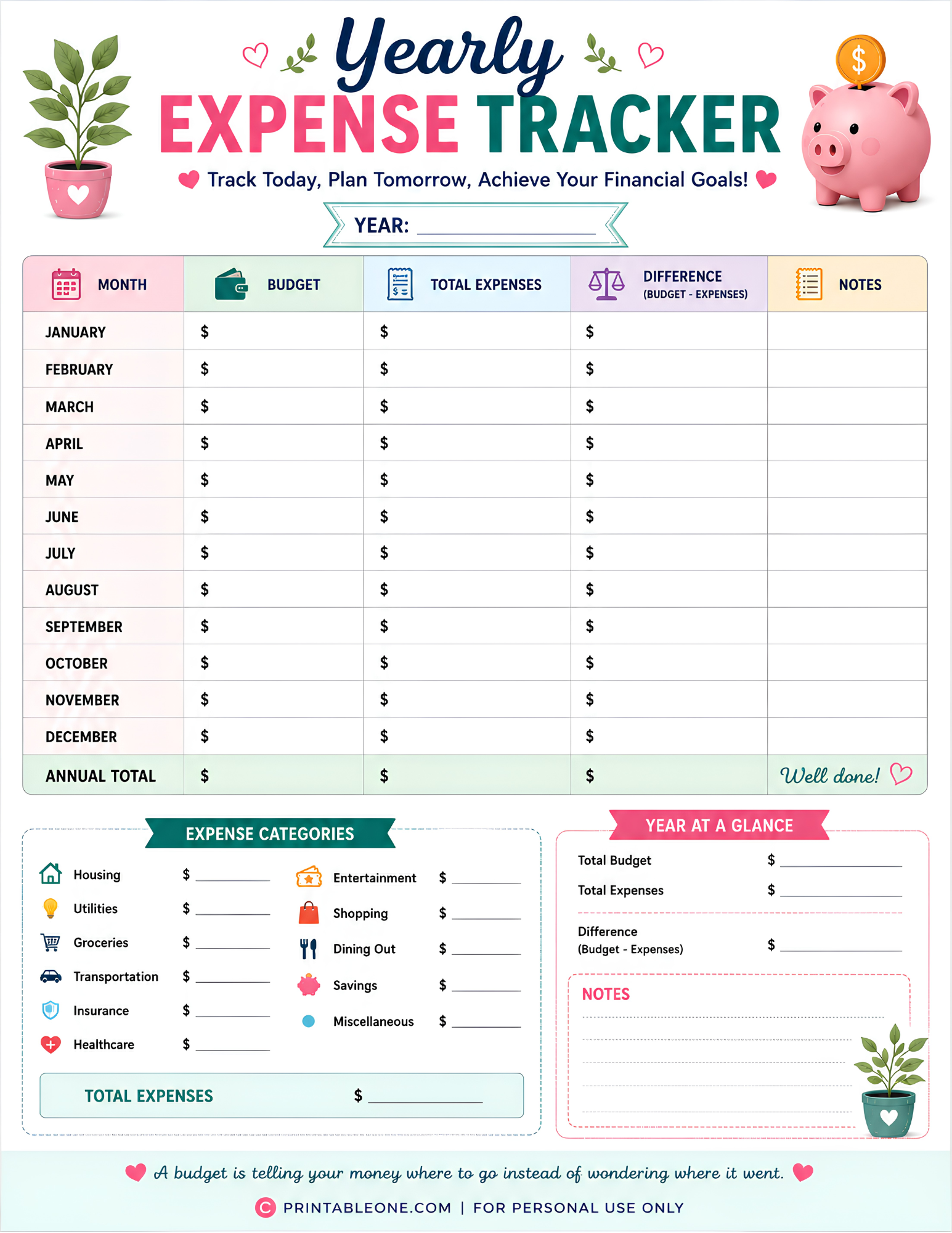
Note: This high-resolution, print-ready PDF is 100% free for personal use. Print a fresh copy at the start of each year to build an organized, sequential historical archive of your personal financial growth.
What Is a Yearly Expense Tracker?
A yearly expense tracker printable is a high-level master ledger designed to aggregate your monthly spending data into a single, cohesive 12-month overview. Think of it as a professional annual expense tracker printable that shifts your perspective away from isolated daily choices and focuses it squarely on your broad financial trajectory. By compiling your expenditures across all four quarters on a physical sheet, you remove the guesswork from your money management and establish true visual accountability over your household economy.
Consistently maintaining a comprehensive yearly spending tracker is highly critical for long-term personal finance success because it exposes hidden structural trends. Many expenses do not occur on a standard monthly rhythm; instead, they hit your accounts quarterly, bi-annually, or annually. If you only look at your money through a tight 30-day window, a sudden property tax bill, an annual insurance premium, or a holiday spending surge can feel like an unexpected crisis. An annual system ensures you track these irregular costs accurately, giving you the foresight required to build reliable cash reserves and stabilize your cash flow.
Furthermore, routinely updating an integrated yearly finance planner dramatically enhances your behavioral relationship with money. When you can see the cumulative impact of your spending choices laid out across an entire calendar year, your mindset shifts. You stop viewing budgeting as a restrictive daily chore and start treating it as an active strategy for asset growth. This bird’s-eye view provides the concrete, empirical data you need to identify hidden cash leaks, measure your exact net saving capacity, and make highly informed financial decisions that protect your future security.
What’s Included?
This premium yearly budget tracker features a highly functional, comprehensive dashboard layout optimized to capture every macro-detail of your annual cash flow:
- Year: A clear heading slot to document the specific calendar year, allowing you to easily organize your multi-year historical archives.
- Monthly Expense Table (January–December): A structured, multi-column matrix designed to map your progress systematically through all 12 months.
- Budget Column: A target zone to log your ideal monthly cost ceilings across your primary spending categories.
- Total Expenses: A dedicated calculation box to sum up your combined actual expenditures at the conclusion of each month.
- Difference (Budget vs. Expenses): A high-visibility variance row showing the exact dollar amount you went over or under budget.
- Annual Total Summary: A centralized zone to calculate your aggregated spending across the entire 12-month cycle.
- Comprehensive Expense Categories: Core tracking slots pre-formatted for seamless sorting:
- Housing: Mortgage payments, rent, property taxes, and home maintenance.
- Utilities: Electricity, natural gas, water, internet, and mobile phone plans.
- Groceries: Primary supermarket shopping, household staples, and pantry supplies.
- Transportation: Auto loans, vehicle fuel, public transit, tolls, and maintenance.
- Insurance: Health, life, auto, homeowners, and disability premiums.
- Healthcare: Doctor co-pays, prescriptions, dental care, and medical deductibles.
- Entertainment: Streaming subscriptions, movie tickets, concerts, and hobbies.
- Shopping: Clothing, footwear, gadgets, and casual retail purchases.
- Dining Out: Restaurants, fast-food runs, coffee shop stops, and food delivery.
- Savings: Contributions to emergency funds, sinking funds, and brokerage accounts.
- Miscellaneous: Pet care, holiday gifts, charitable donations, and unexpected fees.
- Year-at-a-Glance Summary: A clean visual chart area to contrast your total annual income against your total annual outgoings.
- Notes Section: A highly flexible, open canvas for mapping out long-term financial goals, documenting unusual windfalls, or brainstorming future adjustments.
- US Letter Size (8.5 × 11″): Formatted natively for standard US printing margins to ensure zero scaling distortions on home printers.
- Instant Download: Immediate, unlimited access to the crisp, professionally designed PDF asset.
How to Use This Yearly Expense Tracker
To extract the maximum value from your annual spending worksheet, build this straightforward, ten-step routine into your financial check-in schedule.
Step 1: Write the Year at the Top of the Worksheet
Begin by writing the current calendar year in the designated heading box on your yearly money tracker. This establishes clear boundaries for your data and ensures clean record-keeping when filing sheets sequentially.
Step 2: Set Your Monthly Budget
Before analyzing actual costs, fill out the baseline budget column for your core categories. Use your historical income and past spending habits to establish realistic targets that push you to save without creating extreme deprivation.
Step 3: Track Total Expenses for Each Month
At the conclusion of each calendar month, aggregate the data from your weekly logs or digital bank statements. Migrate the total sum spent in each category onto your expense tracker printable.
Step 4: Compare Your Budget with Actual Spending
Contrast your actual category totals against the initial targets you set in Step 2. Take note of any areas where your real-world outlays deviated significantly from your structural plan.
Step 5: Calculate the Monthly Difference
Subtract your total actual monthly expenses from your target monthly budget. A positive number indicates a healthy surplus (under budget), while a negative number highlights a deficit that requires closer attention.
Step 6: Fill in Your Expense Categories
Ensure every transaction over the 30-day period is captured within the appropriate row. Maintaining uniform classification across all 12 months is vital for ensuring your final annual totals are completely accurate.
Step 7: Calculate Annual Totals
At the end of December, add up each monthly column horizontally across the page. This calculation reveals the exact amount of money you deployed into housing, groceries, transport, and lifestyle luxuries over the full year.
Step 8: Review Spending Trends
Analyze the filled-out sheet objectively. Look closely at how your costs shifted between seasons—such as higher utility bills in the summer or elevated shopping metrics during the winter holidays.
Step 9: Identify Areas Where You Can Save
Pinpoint the categories that consistently triggered budget overruns. Use these visual insights to locate unnecessary spending leaks and determine exactly where you can cut back to optimize your future cash flow.
Step 10: Use Your Notes Section for Goals and Reminders
Document your key takeaways in the open notes block. Write down major milestones hit, track interest rate changes, or outline the specific strategic tweaks you want to apply to your upcoming annual budget worksheet.
Benefits of Using a Yearly Expense Tracker
Transitioning your financial oversight to a comprehensive yearly financial planner provides powerful structural and psychological advantages that digital dashboards often fail to deliver.
View Your Entire Financial Year
A yearly ledger removes the tunnel vision of short-term budgeting. It allows you to step back and look at your personal finances as a cohesive system, tracking your net worth and asset allocation across a meaningful timeline.
Stay Within Your Annual Budget
Breaking down large annual financial targets into twelve distinct monthly segments makes your macro-goals completely manageable. It provides ongoing structural boundaries that keep your spending choices stable all year long.
Identify Spending Trends
Tracking over 12 months makes your personal economic cycles glaringly obvious. You can easily spot recurring surges, map out seasonal resource strains, and prepare your bank accounts for predictable annual spikes.
Reduce Unnecessary Expenses
When you see minor monthly overruns multiplied by twelve, the true cost of casual spending becomes undeniable. Realizing that a small convenience habit costs hundreds of dollars annually provides strong motivation to cut back.
Improve Financial Planning
Empirical historical data is the foundation of clean financial planning. Having a physical record of what it actually cost to run your life over the past year allows you to build highly accurate future budgets.
Build Better Money Habits
Sound money management relies entirely on consistency. Interacting with your master sheet every single month systematically strengthens your financial focus, building the self-discipline needed to maintain excellent lifetime money habits.
Reach Long-Term Financial Goals
Whether you are working to eliminate consumer debt, buy real estate, or build a retirement fund, a yearly tracking sheet keeps your focus sharp. It bridges the gap between today’s small choices and tomorrow’s major milestones.
Prepare for Future Budgets
Instead of guessing or using arbitrary numbers when designing next year’s budget, you can use real, proven financial history. This accurate baseline ensures your upcoming plans are completely realistic and highly effective.
Common Expense Categories
To ensure your yearly budgeting printable remains clean, organized, and highly actionable, group your annual transactions into these standardized categories:
- Housing: Principal mortgage payments, monthly rent, property taxes, home insurance premiums, and maintenance costs.
- Utilities: Electricity, natural gas, water, trash collection, high-speed internet, and mobile phone plans.
- Groceries: Standard supermarket shopping trips, whole foods, fresh produce, and essential household paper goods.
- Transportation: Auto loan payments, vehicle insurance premiums, fuel costs, public transit passes, parking, and maintenance.
- Insurance: Health, dental, vision, life, disability, and umbrella policy premiums not deducted from your paycheck.
- Healthcare: Medical doctor co-pays, prescription medications, dental procedures, and unexpected hospital expenses.
- Shopping: Clothing collections, footwear updates, home decor, electronics, and casual retail purchases.
- Dining Out: Restaurant dinners, fast-food runs, coffee shop visits, bar tabs, and convenient food delivery apps.
- Entertainment: Concert tickets, sporting events, movie rentals, and recurring digital streaming platforms.
- Education: College tuition fees, student loan interest payments, textbooks, school supplies, and professional certifications.
- Savings: Core allocations toward emergency funds, down payments, sinking funds, and retirement accounts.
- Travel: Vacation flights, hotel bookings, luggage expenses, and out-of-town dining outlays.
- Subscriptions: Annual software renewals, gym memberships, or monthly curation boxes.
- Miscellaneous: Pet care supplies, holiday gifts, dry cleaning bills, and unexpected minor costs.
Tips for Tracking Yearly Expenses
Simply downloading a printable finance worksheet won’t transform your financial life; real change requires executing the routine flawlessly. Use these pro strategies to optimize your annual tracking results:
Update Your Tracker Every Month
Do not leave your tracking tasks until the end of the year. Set a recurring calendar reminder on the final day of each month to pull your data together and update your master yearly ledger while the numbers are fresh.
Save Receipts and Statements
Maintain a dedicated physical folder or digital drive labeled for the current year. File every monthly bank statement, credit card ledger, and major receipt systematically to make end-of-month tallying simple.
Review Spending at the End of Each Month
Treat your personal finance like a business. Spend fifteen minutes at the end of every month reviewing your numbers, tracking category growth, and checking your progress against your initial targets.
Compare Each Month’s Expenses with Your Budget
Look closely at variances. If you discover that your actual spending consistently blew past your budget for three months straight, don’t ignore it—adjust your targets to match your actual lifestyle needs.
Watch for Seasonal Spending Increases
Anticipate cyclical budget strains before they happen. Plan ahead for predictable spending spikes, such as higher cooling costs in July, back-to-school expenses in August, or holiday shopping bills in November and December.
Adjust Your Budget When Needed
Life throws curveballs. If you experience a shift in income, a change in rent, or a new insurance rate, update your budget column immediately. A good financial plan should be flexible enough to handle real-world changes.
Set Yearly Savings Goals
Give your tracking efforts a clear purpose. Establish a specific, total dollar amount that you intend to save or invest over the 12-month cycle, write it down on your sheet, and fund it consistently.
Review Your Annual Totals Before Creating Next Year’s Budget
Before printing a fresh tracker for the upcoming year, spend time reviewing your completed totals. Use these final numbers to identify permanent lifestyle costs and build an even smarter plan for the year ahead.
Common Budgeting Mistakes
Protect your financial momentum by identifying and avoiding these common year-over-year tracking traps:
- Ignoring Small Monthly Expenses: Disregarding minor recurring charges because they look small in isolation will leave a massive, unexplained gap in your annual total calculations.
- Forgetting Yearly Subscriptions: Failing to budget for annual auto-renewals (like Amazon Prime, warehouse club fees, or software licenses) can catch your checking account off guard.
- Overspending During Holidays: Treating November and December as an excuse to completely ignore your budget can quickly wipe out months of hard work and savings.
- Not Reviewing Annual Spending: Filling out your worksheet monthly but never reviewing the historical data turns tracking into an empty chore. Always analyze the trends to improve your habits.
- Setting Unrealistic Budgets: Designing an overly restrictive, perfect budget that leaves zero room for lifestyle enjoyment often leads to extreme frustration and eventual burnout.
- Failing to Track Recurring Expenses: Overlooking fixed bills that are automatically deducted from your account can cause you to consistently underestimate your actual outgoings.
- Waiting Until Year-End to Review Finances: Trying to compile 12 months of bank transactions all at once in December is incredibly overwhelming and prevents you from making course corrections during the year.
Monthly vs. Yearly Expense Tracking
Understanding how short-term monthly tracking pairs with your long-term yearly planning is essential for building a highly effective, comprehensive personal finance strategy.
| Feature | Monthly Expense Tracking | Yearly Expense Tracking |
| Data Scope | Focuses heavily on a single 30-day window | Covers the full 12-month calendar cycle |
| Primary Goal | Tracks short-term spending and daily cash flow variables | Identifies annual trends and macro cost variations |
| Operational Impact | Makes it easy to adjust habits week-to-week | Better for long-term lifestyle planning and investments |
| Core Value | Helps you stay inside your immediate monthly budget | Supports broad financial planning and annual wealth goals |
Who Should Use This Printable?
This highly adaptable household expense tracker is designed to bring value, structure, and clarity to individuals across all walks of life:
- Families: A fantastic resource for managing large household economies, tracking total grocery costs, and planning for seasonal family expenses.
- Students: An ideal tool for learning the fundamentals of cash flow early and tracking the total annual cost of housing, tuition, and textbooks.
- Couples: Provides an objective, completely transparent framework for couples to discuss long-term dreams and stay aligned on their shared path.
- Freelancers: Essential for tracking unpredictable annual income streams, calculating net profit margins, and managing irregular business expenses.
- Small Business Owners: Great for cataloging high-level annual overhead costs, separating drawings from revenues, and preparing clean numbers for tax season.
- Budget Binder Users: Formatted to fit standard binder systems, serving as the primary master overview for your entire financial notebook.
- Anyone Managing Yearly Finances: Whether you are working to escape consumer debt or managing a high income, this worksheet brings valuable clarity to your long-term habits.
Frequently Asked Questions
Is this Yearly Expense Tracker free?
Yes. This downloadable resource is 100% free to print and use for all personal budgeting, home tracking, and financial planning purposes.
What paper size is it?
The printable document is professionally designed at standard US Letter size (8.5 × 11 inches), ensuring a clean, easy print on standard home machines.
Can I print multiple copies?
Absolutely! You can print multiple sheets if you like to track separate categories independently, or if you want to keep your personal household budget and your small business finances completely separate.
Can I use one every year?
Yes. Printing out a fresh sheet at the start of every January allows you to track your progress year after year, building a valuable historical record of your financial growth.
Is it beginner friendly?
Yes, it features a highly intuitive layout. You do not need any advanced accounting or spreadsheet experience to use it—simply grab a pen and a calculator, fill in the blanks, and update your numbers monthly.
Can I laminate it?
Laminating your tracking sheet is an excellent idea. It allows you to use dry-erase markers to easily update your monthly totals and make quick corrections without having to print a new page.
Can I use it alongside other finance printables?
Definitely. This master sheet serves as the ultimate high-level hub that pairs perfectly with your existing weekly expense trackers, monthly budget sheets, cash envelope printables, and long-term savings logs.
Related Printables
To build a fully customized, highly effective home management binder, check out these excellent complementary finance printables:
- Daily Expense Tracker Printable
- Weekly Expense Tracker Printable
- Income & Expense Tracker Printable
- Monthly Budget Planner Printable
- Annual Budget Planner Printable
- Monthly Savings Tracker Printable
- Financial Goals Worksheet Printable
- Net Worth Tracker Printable
- Bill Payment Tracker Printable
- Subscription Tracker Printable
- Cash Envelope Tracker Printable
- Sinking Fund Tracker Printable
- Debt Payoff Tracker Printable
- Debt Snowball Tracker Printable
- No Spend Challenge Printable
- 52 Week Savings Challenge Printable
- 100 Envelope Challenge Printable
- Emergency Fund Tracker Printable
Final Thoughts
Achieving true financial peace of mind doesn’t happen by accident; it requires clear structure, regular tracking, and an honest look at your long-term habits. By using this yearly expense tracker printable, you stop managing your money reactively and start directing it with purpose. You transition from a short-term, month-to-month survival mindset to a position of true long-term financial control. Lay out your category limits, update your monthly totals consistently, analyze your seasonal trends, and eliminate the hidden leaks draining your net worth. Download your free printable today, stick to the process, and take control of your finances one year at a time.