
Taking control of your personal finances can often feel like an uphill battle, especially if traditional budgeting methods leave you feeling uninspired. If you have struggled to stick to a savings plan in the past, you are not alone. Maintaining consistency is one of the biggest hurdles in building wealth. That is exactly why gamified financial routines and structured money management frameworks have taken the world by storm, and none have made a more profound psychological impact on preparing for upcoming expenses than a dedicated sinking fund tracker printable.
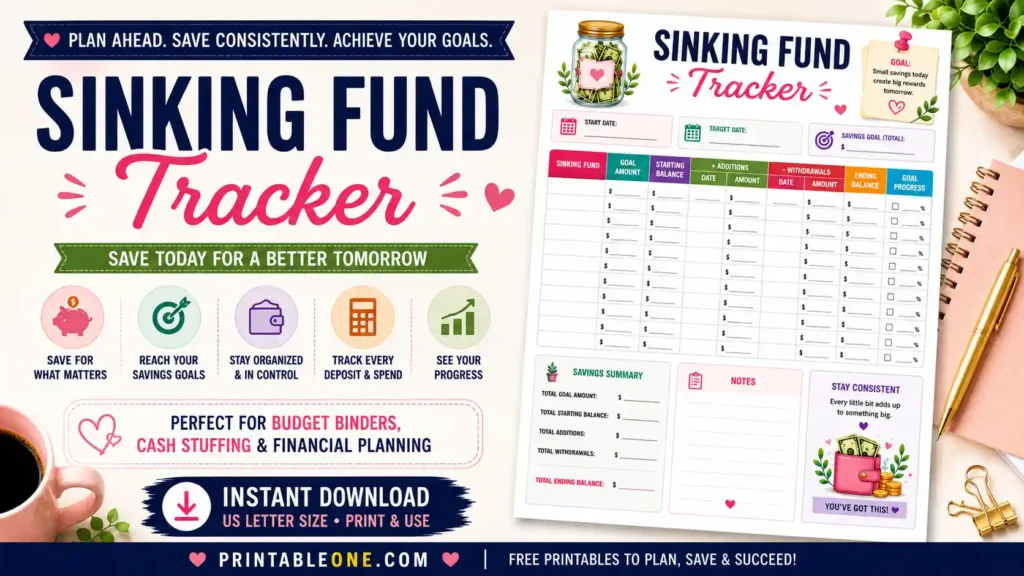
Planning ahead is one of the smartest ways to stay financially prepared and protect your hard-earned cash from unexpected drops. This premium sinking fund tracker helps you save money for future target expenses by organizing your specific milestones, tracking individual contributions, and monitoring your long-term progression. Missing or ignoring these anticipated seasonal bills can lead to sudden high-interest credit card debt that quickly derails your financial freedom. By downloading our free sinking fund worksheet, you transform a tedious chore into an organized, visual routine. This intuitive dashboard helps you consolidate your cash reserves, target totals, and timeline entries in one convenient place, giving you total clarity over your financial future before large bills strike your bank account.
Whether you’re saving for the holidays, a dream vacation, major home renovations, or your vehicle’s annual upkeep, this free sinking fund printable makes it easy to stay on track. Our high-quality savings tracker printable layout is available for instant download, completely free of charge, and precision-formatted for standard US Letter size (8.5 × 11 inches). Whether you want a physical tracking sheet to slip into your daily budget binder printable or a versatile sinking fund template for your tablet, this tool provides the exact structural framework you need to build healthier money habits. Print unlimited copies and use it every single month to keep your financial goals perfectly organized.
Download Your Free Sinking Fund Tracker Printable
Ready to eliminate financial anxiety and establish absolute organization over your future expenses? Choose your preferred file format below for an instant download.
Print File Details
- File Format: High-resolution, ink-friendly PDF & PNG options
- Dimensions: Standard US Letter Size (8.5 × 11 inches)
- Cost: 100% Free download
- Printability: Optimized for crisp home printing
Download Your Free Sinking Fund Tracker Printable
Plan ahead and save with confidence using this free Sinking Fund Tracker Printable PDF. Track your savings goals, monitor deposits and withdrawals, review your progress, and stay organized for future expenses with this easy-to-use printable planner.
What Is a Sinking Fund Tracker?
A sinking fund tracker is a specialized financial worksheet designed to capture, display, and verify your strategic, targeted savings allocations in a clean, goal-driven format. Rather than relying on a single, messy bank balance where your money is easily spent, a visual sinking fund planner functions as a centralized accounting checklist for specific future cash obligations. It bridges the gap between your regular monthly income and your irregular, large expenses, ensuring that no major holiday, annual premium, or predictable repair catches your wallet off guard.
Think of it as a proactive defense shield for your primary bank account. When you manage a comprehensive sinking fund savings tracker, you move from a reactive state of scrambling when a large expense arises to a confident stance of predictable cash management. A dedicated printable sinking fund tracker acts as a visual map, showing you precisely how close you are to fully funding individual lifecycle milestones.
By tracking your savings visually, you gain immediate clarity on your true financial runway. The underlying philosophy of a sinking funds budget involves breaking down a large, future financial obligation into small, equal monthly contributions. For instance, instead of trying to find $1,200 for holiday shopping in November, a budget sinking fund structure allows you to save a highly manageable $100 every month starting in January. Monitoring your deposits and withdrawals on a dedicated tracking dashboard is the absolute foundation of stopping impulse spending, mastering a cash stuffing sinking fund, and building lasting wealth.
Sinking Fund vs. Emergency Fund
While both accounts are essential pillars of a secure financial goal planner, they serve completely distinct behavioral roles:
- Sinking Funds: Designed for planned, predictable future expenses with a specific timeline and a defined savings target. You know the expense is coming, you know roughly when it will occur, and you use the money regularly throughout the year (e.g., vacations, holiday gifts, vehicle maintenance, or annual insurance premiums).
- Emergency Funds: Designed for unplanned, completely unpredictable financial shocks. This money serves as a general financial safety net and is kept locked away strictly for urgent crises, such as a sudden job loss, major medical emergencies, or catastrophic property damage.
What’s Included in This Free Tracker?
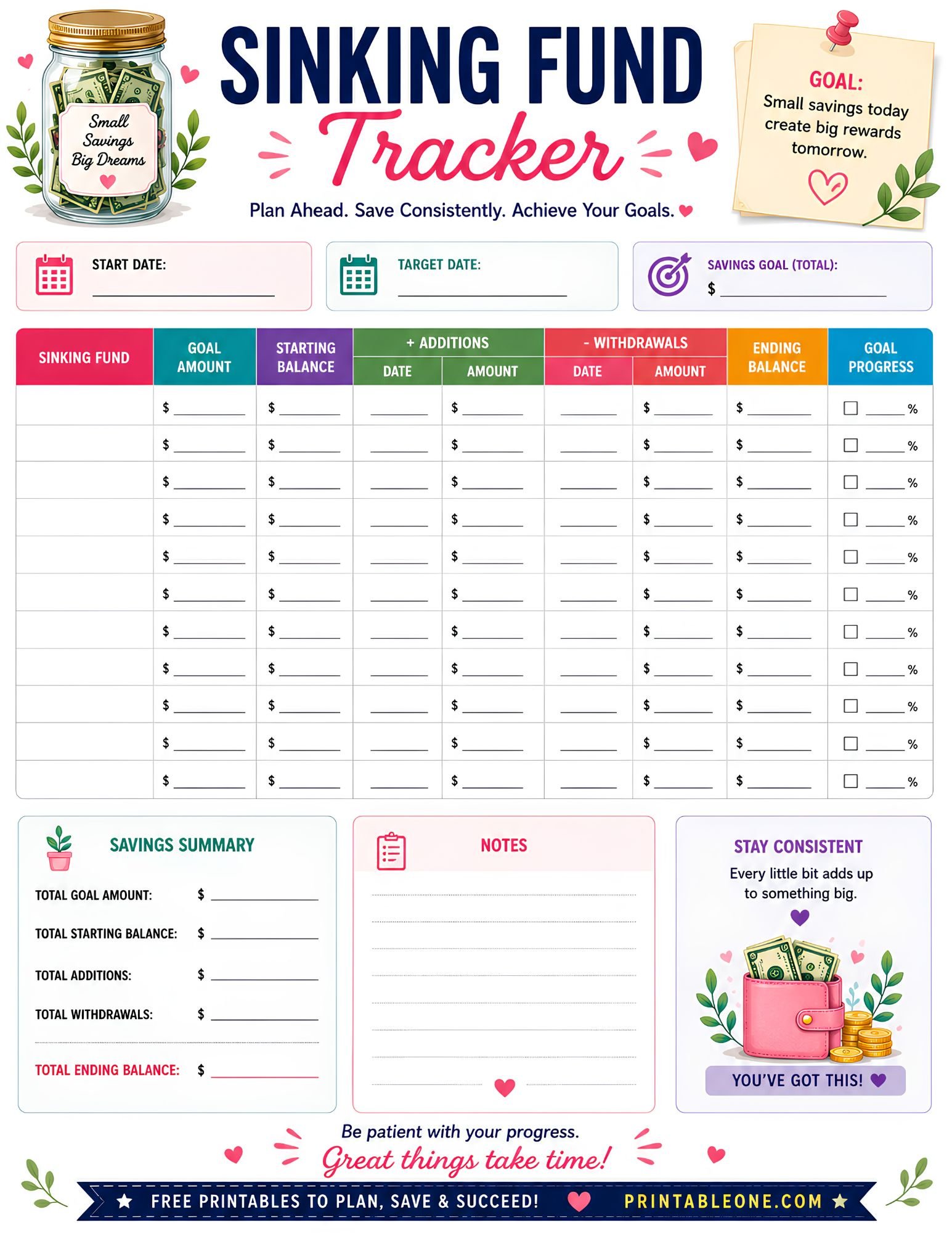
We engineered this printable savings planner framework to be clean, intuitive, and highly functional. Your instant download package includes everything you need to document your target categories across a beautifully balanced single-page layout:
- Sinking Fund Name Block: Wide, high-visibility title fields to define the explicit purpose of each individual savings fund (e.g., “New Car Fund” or “Christmas 2026”).
- Savings Goal Tracker Box: A dedicated structural block to write out your ultimate target dollar amount, serving as a clear finish line.
- Starting Balance Column: Dedicated entry rows to log the exact amount of cash your fund holds at the beginning of your tracking cycle.
- Deposits & Withdrawals Ledger: Clear, adjacent bookkeeping columns to track cash additions (like pay-period savings) and cash subtractions as you spend.
- Ending Balance Field: An active accounting module to calculate the real-time cash balance currently sitting inside the fund.
- Visual Goal Progress Chart: A beautifully styled tracking graphic designed to be colored in incrementally as your balances climb.
- Comprehensive Savings Summary: A mathematical calculation block at the base of the page to compute your total combined sinking fund assets.
- Notes Section: Clean, lined space to sketch out savings milestones, bank account interest payouts, or timeline adjustments.
- US Letter Format: Precision-engineered margins tailored specifically for standard 8.5 × 11-inch home printer paper.
How to Use the Sinking Fund Tracker Printable
Configuring your free sinking fund printable takes less than fifteen minutes. Follow this simple seven-step roadmap to maximize your visual tracking success.
[Name Sinking Fund] ➔ [Set Savings Goal] ➔ [Record Starting Balance] ➔ [Log Payday Deposits] ➔ [Record Spent Cash] ➔ [Compute Ending Balance] ➔ [Audit Monthly Progress]Step 1 – Write Your Sinking Fund Name
Begin by assigning a clear, specific title to your tracking block. Focus on one distinct financial goal per layout sheet to keep your calculations clean. If you are saving for a vacation and car maintenance simultaneously, print out two separate copies so each category has its own visual home.
Step 2 – Enter Your Ultimate Savings Goal
Calculate the exact dollar value required to fully fund your target expense. If you are preparing for holiday shopping, look at your historical spending trends to set a realistic, firm cap. Write this final target number prominently in the goal block to serve as your operational finish line.
Step 3 – Record Your Starting Balance
Look into your checking or savings accounts to see how much money you have already set aside for this category. Log this baseline figure in the Starting Balance row to anchor the beginning of your current tracking cycle.
Step 4 – Track Every Payday Deposit
Every single time you move cash into your fund, whether through an automated bank transfer, a payday allocation, or side hustle earnings—log the transaction details immediately in the deposit row. Shading in your progress charts every time you make a deposit creates a highly motivating visual feedback loop.
Step 5 – Record Withdrawals When Spending
When the time arrives to pay for the planned expense (such as purchasing a plane ticket or booking a vehicle tune-up), withdraw the necessary cash from your fund. Document the transaction date and the exact amount spent in the withdrawal column to keep your balances perfectly accurate.
Step 6 – Calculate and Update Your Ending Balance
Run your baseline math regularly. Take your starting balance, add all recent deposits, and subtract your total withdrawals to compute your updated Ending Balance. Keeping this number current ensures you always know your exact remaining purchasing power.
Step 7 – Review Your Savings Progress Every Month
At the close of the month, perform a comprehensive review of your tracking sheet. Evaluate your savings velocity, check your timeline goals, and adjust your monthly contributions if necessary to ensure you hit your targets on time.
Popular Sinking Fund Categories to Track
An open-ended tracking system allows you to build a highly customized defense system tailored to your unique lifestyle. Consider creating separate sheets for these popular sinking fund categories:
- Vacation & Travel: Stacking up cash for airline tickets, resort bookings, dining out, and vacation spending money so you can travel completely debt-free.
- Christmas & Holidays: Saving small amounts month-by-month starting in January so you can buy gifts, fund travel, and cook festive dinners without any December stress.
- Birthdays & Special Events: Pre-funding birthday gifts, wedding presents, anniversary dinners, and milestone parties throughout the year.
- Home Repairs & Upgrades: Amassing a dedicated maintenance pool to handle routine plumbing adjustments, roof care, major appliance replacements, or decorative interior upgrades.
- Car Maintenance & Repairs: Preparing for oil changes, seasonal tire swaps, brake replacements, and annual vehicle registration fees before they arrive.
- Irregular Insurance Premiums: Setting aside small monthly amounts to pay for semi-annual or annual auto, home, or life insurance bills, allowing you to avoid expensive monthly processing surcharges.
- Medical & Dental Expenses: Stacking cash to cover deductible limits, prescription co-pays, routine cleanings, or unexpected optical needs smoothly.
- School Supplies & Tuition: Pre-funding back-to-school clothing, textbooks, field trips, technology upgrades, or private tuition payments well ahead of the fall term.
- Electronics & Tech Upgrades: Gradually saving up for your next smartphone replacement, laptop upgrade, or home entertainment purchase.
- Furniture & Appliance Pools: Stacking capital step-by-step for a new mattress, living room set, or major kitchen appliance without relying on high-interest store financing.
- Pet Care Expenses: Structuring a reserve for annual veterinary check-ups, vaccine routines, grooming needs, and dietary staples.
- Wedding Milestones: Managing venue deposits, catering fees, floral arrangements, and formal wear payments systematically over your engagement.
- Baby & Family Planning: Stacking a financial cushion for nursery setups, clothing arrays, medical expenses, and parental leave buffers.
- Emergency Travel Funds: Keeping a dedicated cash cushion to cover last-minute flights or hotel stays for family needs without derailing your main budget.
The Benefits of Using a Sinking Fund Tracker Printable
Why should you rely on a physical, handwritten document from PrintableOne.com instead of a hidden bank menu? Visual tracking tools completely reshape your relationship with money.
- Save Money Completely Without Stress: Breaking a large, intimidating bill down into bite-sized monthly steps removes the panic from budgeting. You can watch your funds grow peacefully over time.
- Avoid Using Credit Cards for Planned Expenses: Sinking funds break the cycle of dependent debt. By paying for vacations and holiday shopping entirely in cash, you protect your wallet from carrying interest balances into the next year.
- Establishes Absolute Organization: Seeing all of your separate savings goals clearly laid out on paper removes the confusion of a single bank balance, giving you clear boundaries for your money.
- Reach Major Financial Goals Significantly Faster: When your progress is fully visible in the real world, you naturally find ways to optimize your cash flow. You will find yourself skipping minor impulse buys just so you can color in another segment on your chart.
- Drastically Reduce Monthly Financial Anxiety: Financial stress often comes from the fear of unexpected upcoming bills. Knowing that your car insurance, holiday gifts, and home repairs are already fully funded brings immense peace of mind.
- Build Healthier, Lasting Budgeting Habits: Regularly interacting with your tracking sheets shifts your daily mindset from reactive spending to long-term, proactive asset allocation.
Sinking Fund vs. Emergency Fund
Choosing where to direct your extra cash flow depends heavily on your current household stability, timeline constraints, and debt limits. Use this comprehensive comparison table to balance your funds correctly:
| Feature & Focus | Strategic Sinking Fund Tracker | Comprehensive Emergency Fund |
| Primary Financial Focus | Planned, Expected Future Expenses | Unplanned, Unpredictable Shocks |
| Savings Goal Structure | Specific & Highly Customized (Defined per sheet) | General Safety Net (Calculated by living costs) |
| Account Lifecycle | Used regularly throughout the year | Touched strictly during urgent crises |
| Typical Cash Examples | Vacations, holiday gifts, vehicle maintenance | Job loss, sudden medical crises, major disasters |
| Psychological Impact | Builds excitement, organization, and focus | Provides long-term security and basic survival protection |
Proven Tips for Growing Your Sinking Funds Faster
Setting up your sheets is a fantastic first step, but maximizing your savings velocity requires active optimization strategies in your daily routine.
1. Automate Your Monthly Savings
Do not rely on your memory or your willpower to save money at the end of the month. Set up an automatic recurring transfer with your bank to move your target monthly sinking fund amounts from your checking account into your savings account the exact morning your paycheck hits. Automating your finances completely removes decision fatigue.
2. Save Small Amounts Consistently
Momentum is everything in behavioral finance. Even if you can only afford to contribute a small $10 or $20 amount to a specific fund each pay period, log it consistently. Regular contributions keep the positive habit alive, and those small amounts compound surprisingly fast over a 12-month window.
3. Prioritize Your Most Critical Financial Goals
If you try to fund fifteen different tracking sheets simultaneously on a tight income, you will spread your cash flow too thin to see meaningful progress. Focus your energy on your top three most urgent categories first (such as car maintenance or upcoming insurance bills) before opening sheets for luxury wants like premium vacations.
4. Review Your Progress Monthly Without Exception
Set a standing monthly appointment to sit down with your printable savings planner documents. Count your physical cash or cross-reference your bank sub-accounts, update your ledgers, and color in your progress graphics. Regular monthly touchpoints keep your financial goals fresh and top-of-mind.
5. Avoid Borrowing from Other Sinking Funds
Treat the cash balances on each sheet as completely locked, sacred capital. Borrowing money out of your vehicle maintenance fund to pay for an impulse retail purchase breaks the structural rules of the system and leaves you vulnerable when real maintenance needs hit.
6. Increase Contributions When Windfalls Hit
Whenever you receive an unexpected cash injection, such as a tax refund, an office bonus, holiday gift cash, or profits from marketplace sales, funnel a chunk of it straight into your active tracking sheets. These sudden deposits can shave months off your savings timelines.
Common Sinking Fund Mistakes to Avoid
Watch out for these behavioral traps that can slow down your momentum or cause you to abandon your tracking sheets entirely:
- Failing to Define a Clear Target Goal Amount: Saving blindly without a firm number makes it incredibly easy to under-fund your upcoming bills. Always calculate a clear, numeric finish line for each sheet.
- Skipping Payday Contributions Regularly: Allowing yourself to miss multiple consecutive deposits breaks your momentum and quickly leads to abandoning the tracker entirely. Maintain consistency, even with tiny amounts.
- Mixing Different Savings Goals in One Ledger: Trying to track your vacation funds, home repairs, and holiday cash on a single, messy line item leads to confusion. Keep your categories completely separate by using a fresh printable copy for each individual goal.
- Using the Stacked Funds Too Early for Desires: Raiding a building travel fund to pay for a temporary weekend convenience buy defeats the entire purpose of the challenge. Keep your money locked until your planned timeline arrives.
- Neglecting to Track Minor Deposits or Interest: Every single dollar adds up. Make sure to log minor cash additions or monthly bank interest payouts to keep your written records matching your actual bank statements.
- Ignoring Regular Progress Reviews: Treating your tracker as a static piece of storage paper rather than an active tool leads to unmonitored spending leaks. Update your charts regularly.
Who Should Use This Printable Tracking Sheet?
Our open-ended formatting is engineered to deliver immediate value to a wide variety of users across different life stages:
- Busy Families: Great for organizing holiday gift budgets, tracking school supply needs, managing home maintenance pools, and planning shared vacations.
- College Students: Ideal for learning independent financial literacy, saving for seasonal textbooks, managing tech upgrades, and tracking holiday travel costs.
- Young Couples: An engaging collaborative tool for partners to coordinate major future milestones, fund upcoming weddings, and plan vacations together.
- Budget Binder Users: Meticulously designed with optimized blank side margins to fit perfectly into standard multi-ring organization binders and planners.
- Cash Stuffing Enthusiasts: Serves as the ultimate paper scoreboard to track physical cash envelopes, teller deposits, and binder cash slots.
- Homeowners & Renters: Perfect for building distinct maintenance buffers to protect against unexpected appliance failures or moving costs.
Frequently Asked Questions
Is this Sinking Fund Tracker Printable completely free?
Yes! Our premium tracker layout is 100% free for your personal money management. You can instantly download the file in high-resolution PDF or PNG format and print as many clean copies as you need.
What paper size is the downloadable file formatted for?
The download is precisely formatted to standard US Letter size (8.5 × 11 inches). It features optimized margins designed to print flawlessly on standard home printer paper without requiring any complex sizing tweaks or margin cropping.
Can I print multiple copies of this worksheet?
Absolutely. We highly recommend printing out a separate sheet for every individual category you want to target. This keeps your vacation tracking entirely separate from your vehicle maintenance or holiday gift funds.
Can I laminate my printed tracker sheets?
Yes! Many personal finance enthusiasts love laminating our templates. This allows you to use a dry-erase marker to update your weekly deposits and withdrawals, meaning you can reuse a single printed sheet indefinitely.
Does it work seamlessly with a standard budget binder?
Yes! The layout is structured with optimized blank margins on the left border specifically so you can punch holes and clip it securely into any standard three-ring organizer or personal binder binder without covering any text.
Can I use this tracking template digitally?
Yes. If you prefer a completely paperless, digital workflow to minimize clutter, you can seamlessly import our PDF download into any note-taking application on your mobile device or tablet (such as GoodNotes or Notability) and track your funds using a digital stylus.
What is the difference between a sinking fund and a standard savings account?
A savings account is simply the physical place where your money is safely stored at the bank. A sinking fund is the specific intention and target assigned to that money. You can easily keep multiple distinct sinking funds inside a single digital savings account by using our printable sheets to track each goal’s progress separately.
Related Printables
True long-term wealth management requires balancing a variety of daily, weekly, and monthly money habits. Once you find your rhythm with our sinking fund planner, supercharge your long-term success by integrating our other specialized tracking sheets:
- Cash Envelope Tracker Printable: A premium scoreboard designed to help you monitor cash stuffing routines, pocket binders, and envelope envelope budgets.
- Monthly Budget Planner Printable: A beautifully streamlined matrix layout to track your primary income streams, fixed overhead bills, and monthly variable costs.
- Expense Tracker Printable: A premium chronological ledger designed to help you organize daily transactions and track category totals with precision.
- Bill Payment Tracker Printable: A high-visibility checklist template designed to monitor fixed recurring baseline liabilities so you never miss a due date.
- Savings Goal Tracker Printable: A visual tracking chart designed to help you organize and celebrate your progress toward major life assets.
- 52-Week Savings Challenge Printable: The ultimate year-long companion tool designed to guide you step-by-step toward an easy $1,378 emergency fund.
- 100 Envelope Challenge Printable: A high-speed, gamified cash-stuffing layout engineered to help you pile up a massive $5,050 in just 100 days.
- No-Spend Challenge Printable: A beautiful visual calendar layout geared toward highlighting days where you completely avoid all non-essential retail spending.
- Debt Snowball Tracker Printable: A highly motivational layout engineered to help you organize personal liabilities from smallest balance to largest for rapid eliminations.
Take Control of Your Future Savings Today
A secure, stress-free financial future isn’t built on complex economic equations or waiting around for an unexpected lottery win. Real, lasting prosperity is forged through simple, intentional daily decisions repeated with absolute consistency.
By stepping up to a regular sinking fund tracking routine, you are making a bold, definitive statement that you are the master of your money, not the other way around. Those daily entries, calculated category balances, and colored progress charts are not tedious chores; they are the literal foundation you are using to build your long-term financial freedom. Every transaction you log on this tracker brings you one step closer to a lifestyle completely free of financial anxiety, debt burdens, and monetary stress.
Don’t let hesitation hold you back from building the peace of mind you deserve. Download your high-resolution tracker right now from PrintableOne.com, fire up your home printer, list your upcoming savings goals, and take that powerful first step toward true financial independence today!