
Taking control of your personal finances can often feel like an uphill battle, especially if traditional budgeting methods leave you feeling uninspired. If you have struggled to stick to a savings plan in the past, you are not alone. Maintaining consistency is one of the biggest hurdles in building wealth.
That is exactly why gamified financial routines and structured money management systems have taken the world by storm, and none have made a more foundational impact on day-to-day cash flow than a dedicated monthly budget planner printable.
By downloading our free monthly budget planner printable, you transform a daunting financial milestone into an engaging, interactive game. Instead of trying to cut back blindly on monthly expenses, this structure gives you a clear, tactical objective every single month. The premise is simple, yet incredibly effective: by organizing your income, fixed liabilities, and savings metrics across a beautiful, tactile page, you naturally eliminate resource leaks and optimize your net worth. By the time you fill out your financial summary at the close of the month, those intentionally tracked dollars pave a smooth path toward financial security.
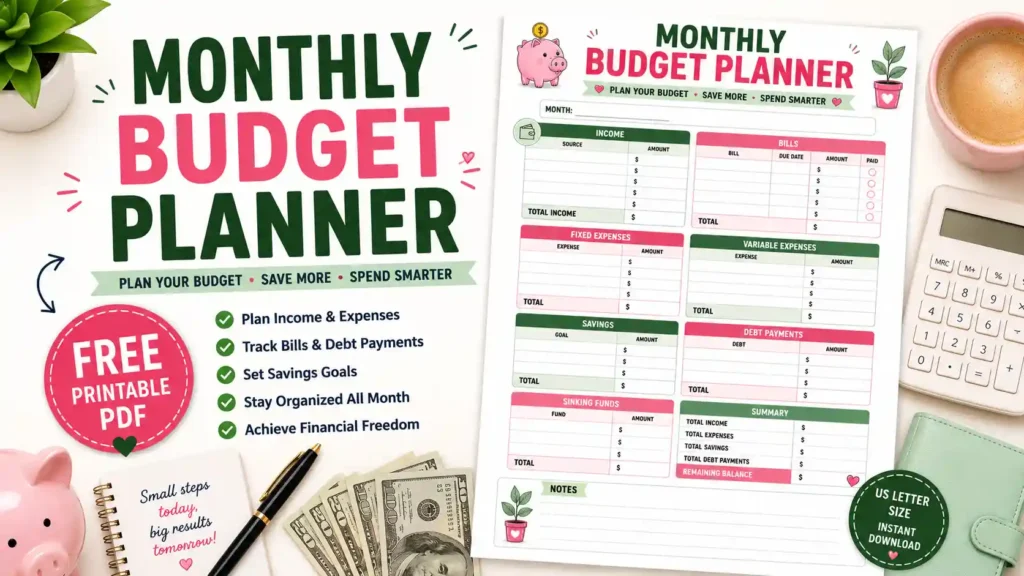
This viral personal budget planner has helped thousands of individuals break out of financial slumps, combat consumer debt, and prove to themselves that organizing cash can actually be deeply satisfying. Our high-quality monthly budget planner template is available for instant download, completely free of charge, and precision-formatted for standard US Letter size (8.5 × 11 inches). Whether you want a physical, printable monthly budget template for your household command center or a versatile budget planner PDF for your tablet, this tool provides the exact visual roadmap you need to build healthier financial habits.
Download Your Free Monthly Budget Planner Printable
Ready to kickstart your personal finance routine and see exactly where your money is going? Choose your preferred file format below for an instant download.
Print File Details
- File Format: High-resolution, ink-friendly PDF & PNG options
- Dimensions: Standard US Letter Size (8.5 × 11 inches)
- Cost: 100% Free download
- Printability: Optimized for crisp home printing
Download Your Free Monthly Budget Planner Printable
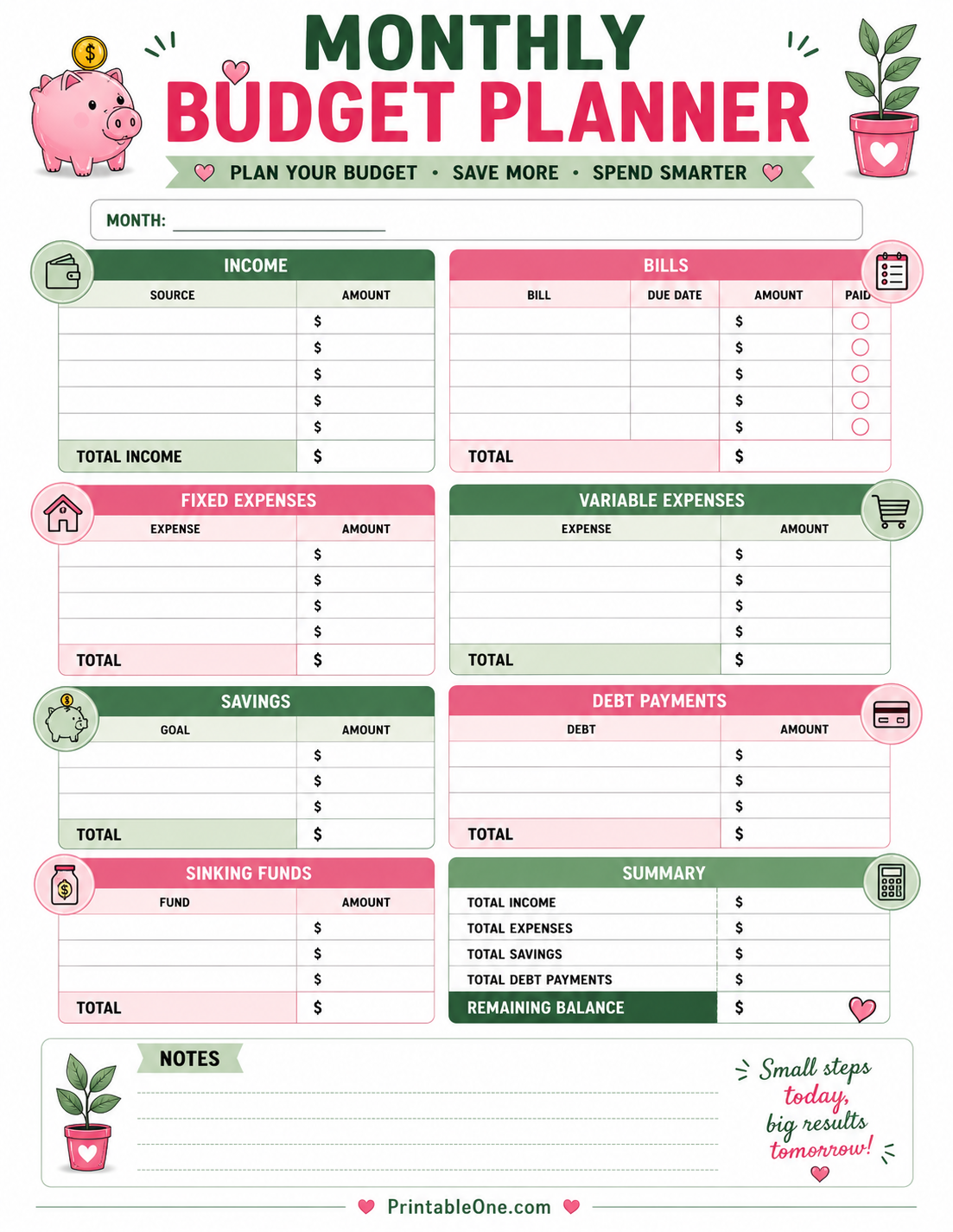
Organize your finances with this free Monthly Budget Planner Printable PDF. Track your income, expenses, bills, savings, debt payments, and monthly goals—all in one easy-to-use planner.
What Is a Monthly Budget Planner?
A monthly budget planner is a structured financial worksheet designed to help you organize your total incoming revenue alongside outgoing liabilities, discretionary expenses, and long-term asset allocations. Utilizing a printable budget planner allows you to map out exactly how every single dollar will behave before the month even begins, removing the stress of unexpected bills.
Think of it as a blueprint for your household finances. Instead of wandering through the month guessing how much capital is left in your checking account, a comprehensive monthly budget template breaks your financial obligations down into clear, visual modules. By pairing a structured budget planner template with a daily monthly expense tracker, you establish a foolproof defense system against lifestyle inflation and impulse purchases.
An open-ended monthly budget worksheet acts as a centralized command center to balance your short-term lifestyle desires against your long-term security. It bridges the gap between raw numbers and daily human behavior, turning the abstract concept of wealth building into a simple, predictable monthly routine.
What’s Included in This Free Monthly Budget Planner?
We engineered this framework to be clean, intuitive, and highly functional. Your instant download package includes everything you need to document your financial ecosystem on a single page:
- Monthly Planning Section: A dedicated block to define the current month, year, and your primary financial focus or motivational goal.
- Income Tracker: Clean fields to log your primary salary alongside side hustles, freelance earnings, dividends, or bonus cash injections.
- Bills Tracker: A highly visible matrix designed to monitor fixed recurring baseline liabilities with checkbox columns for payment confirmation.
- Fixed Expenses Block: Dedicated rows for necessary baseline living categories like grocery staples, transport fuel, and childcare costs.
- Variable Expenses Matrix: A tracking module to keep tabs on highly fluctuating discretionary categories such as dining out, retail shopping, and entertainment.
- Savings Goals Module: An integrated allocation field to document money targeted for your emergency fund, vacation planning, or investments.
- Debt Payments Tracker: Specific rows to list extra cash directed toward credit card paydowns, student loans, or auto liabilities.
- Sinking Funds Layout: A strategic module to save small amounts monthly for irregular, semi-annual costs like insurance premiums or vehicle registration.
- Comprehensive Budget Summary: A mathematical calculation block at the base of the page to compute your Total Income minus Total Expenses to find your remaining baseline.
- Notes Section: Clean, lined space to sketch out side income ideas, list tracking reminders, or note grocery budget shifts.
- US Letter Format: Precision margins tailored specifically for clean, borderless home printing on standard 8.5 × 11-inch printer paper.
How to Use This Monthly Budget Planner Template
Configuring your free household budget planner takes less than twenty minutes at the start of each month. Follow this simple seven-step roadmap to maximize your visual tracking success.
[Write Monthly Income] ➔ [List Fixed Bills] ➔ [Track Fixed Costs] ➔ [Log Variable Spending] ➔ [Allocate Savings] ➔ [Insert Debt Repayments] ➔ [Review Remaining Balance]Step 1 – Write Your Monthly Income
Begin by listing all incoming cash sources expected over the next 30 days in the income module. Include your predictable day-job base salary, but don’t forget to incorporate incoming cash from side income streams, weekend freelance work, cash apps, or marketplace sales. Sum them up to establish your total monthly baseline revenue.
Step 2 – List Your Recurring Bills
Next, populate your bills tracker with your fixed, non-negotiable structural overhead. Write down your exact mortgage or rent installment, followed by monthly utility bills (electricity, water, trash), auto insurance, internet, and recurring digital subscriptions. Write in the exact due dates and use the checkbox column the moment the transfer clears your bank.
Step 3 – Account for Fixed Living Expenses
Move into your operational everyday necessities. These are categories that you must fund to survive and work, but where you have minor control over the exact total. Allocate realistic limits for grocery store trips, public transit passes or vehicle fuel, routine medical needs, and childcare requirements.
Step 4 – Establish Limits for Variable Expenses
This is the area where most budgets experience massive luxury leaks. Set clear structural boundaries for your discretionary wants. Limit your allowance for retail fashion shopping, streaming entertainment adjustments, weekend bar tabs, and dining out at restaurants or fast-food venues. Be conservative but realistic—depriving yourself completely leads to budget burnout.
Step 5 – Add Your Savings Goals
Prioritize your future self by defining your asset allocations. Allocate a specific amount of cash to be transferred into a high-yield savings account. Whether you are building a primary emergency fund, stacking capital for a vacation fund, pre-funding Christmas savings, or saving for a future house down payment, document it clearly here.
Step 6 – Track Debt Payments
If you are currently executing a structured debt repayment plan, write down your targeted debt obligations. List your required minimum payments alongside any extra cash generated by side hustles that you plan to launch against outstanding credit cards, student loans, personal loans, or your car loan.
Step 7 – Review Your Remaining Balance
Run your final monthly calculations. Take your Total Income and subtract every single bill, expense, savings allocation, and debt payment listed on your sheet. Your goal is to achieve a balanced equation where your remaining surplus equals exactly zero because every single dollar has been intentionally assigned a home. If your number drops into a negative balance, audit your variable wants section and trim back until you balance out safely.
The Benefits of Using a Monthly Budget Planner Printable
Why should you rely on a physical, handwritten sheet from PrintableOne.com instead of a complex digital mobile application? Tactile tracking systems deliver significant cognitive and behavioral advantages.
- Helps Control Emotional Spending: The act of physically writing down your budget numbers forces a deeper level of mental awareness than tapping a digital button. It creates psychological friction that makes you think twice before spending money.
- Saves More Money Automatically: When you see all of your financial leaks laid out clearly on a single page, you naturally find areas to optimize. You will easily spot minor convenience costs that can be safely redirected into your savings or debt payoffs.
- Reduces Chronic Financial Stress: Anxiety often stems from a lack of clarity. Knowing exactly where every single dollar is destined to go eliminates the fear of the unknown, giving you a deep sense of control over your lifestyle.
- Keeps Regular Bills Highly Organized: No more missed deadlines or annoying late fees. Having a dedicated visual bills tracker with tactile checkboxes guarantees your critical utility and housing costs remain perfectly visible.
- Improves Long-Term Money Habits: Regularly engaging with a budget planner printable free of charge builds deep financial discipline over time. It shifts your baseline mindset from impulsive consuming to strategic, intentional resource allocation.
Monthly Budget Planner Template vs. Digital Spreadsheet
Choosing the right personal finance tool depends heavily on your daily environment, career style, and personal habits. Use this comparison table to evaluate the core structural differences:
| Feature & Operational Attributes | Printable Budget Planner Sheet | Digital Cloud Spreadsheet |
| Accessibility Limits | Extremely Easy to Print (No tech required) | Requires a desktop device, tablet, or smartphone |
| Data Entry Style | Satisfying Handwritten interaction | Digital keyboard only |
| Collaborative Flow | Great for Families (Can hang on the fridge) | Shared via cloud link accounts |
| Progressive Design | Tactile, Visual Planning framework | Grid-based rows and column lines |
| Mathematical Structure | Manual addition forces habit awareness | Automated formula-based cell calculations |
| Screen Time Impact | 100% Offline (Reduces digital fatigue) | Adds to daily screen exposure |
Digital spreadsheets are fantastic for tracking data sets with formulas over multiple years, but they are often easy to close out and forget. A physical free monthly budget planner layout stays anchored in the real world, serving as a constant visual reminder of your financial goals every time you walk into your kitchen or office.
Example of a Balanced Monthly Budget Blueprint
To understand how these categories interact smoothly in a real household scenario, review this standard example budget configuration based on a net incoming monthly revenue of $4,000:
[Total Net Income: $4,000]
   ├── Housing Allocation:      $1,200 (Rent or Mortgage)
   ├── Utility Bills Matrix:    $250   (Power, Water, Cellular)
   ├── Grocery Store Staples:   $450   (Home-cooked nutrition)
   ├── Commuter Transportation: $250   (Auto fuel and insurance)
   ├── Strategic Savings:       $500   (Emergency fund deposit)
   ├── Debt Repayments Engine:  $350   (Credit card / Student loan)
   ├── Discretionary Fun:       $200   (Dining out / Entertainment)
   └── Remaining Cash Balance:  $800   (Unallocated structural buffer)
By organizing your capital into dedicated modules, you see exactly how a standard $4,000 incoming paycheck can safely cover your survival needs and lifestyle desires while still funneling a strong $850 chunk into your savings and debt reduction goals.
Practical Budgeting Tips to Maximize Success
Setting up your printable tracking sheet is a fantastic first step, but staying consistent over the long haul requires practical optimization strategies.
1. Implement the 50/30/20 Rule
If you find yourself confused about how much money to assign to each category, use this classic financial rule of thumb as a helpful baseline guide:
- 50% for Needs: Dedicate half of your income to critical survival overhead (housing, utilities, groceries, basic transit).
- 30% for Wants: Keep nearly a third of your money available for discretionary lifestyle choices (dining out, entertainment, fashion shopping).
- 20% for Savings: Funnel the remaining fifth of your income directly into building wealth, funding emergencies, or wiping out principal debts.
2. Review Your Spending Patterns Weekly
Do not wait until the final evening of the month to update your planner sheets. Pick an easy weekly appointment—like every Sunday morning—to pull up your bank transactions, review your receipts, and log your numbers. Weekly check-ins catch potential overspending early, giving you plenty of time to adjust your habits before the month ends.
3. Build a Sturdy Emergency Fund First
Before you start allocating heavy cash flow toward variable lifestyle luxuries, ensure your financial baseline is fully protected. Focus on amassing a starter safety cushion of $1,000 to $2,500 to safeguard your household against unexpected car repairs or medical costs without needing to swipe a credit card.
4. Pay Your Future Self First
The moment your primary employer paycheck hits your checking account, execute your automated savings transfers immediately. Do not wait to see what cash happens to be left over on Day 30 after casual spending. Treating your savings allocation like a non-negotiable bill ensures your wealth grows predictably every single month.
5. Track Every Single Dollar
Maintain absolute precision. Even minor cash transactions or small digital app purchases need to be accounted for in your variable expense tracker. Those unnoticed $5 convenience store stops can quietly add up to hundreds of dollars of hidden leaks over a 30-day window if left unchecked.
Common Budgeting Mistakes to Watch Out For
To safeguard your hard work and ensure you cross the monthly finish line seamlessly, watch out for these common traps:
- Forgetting Irregular and Small Expenses: Leaving out irregular annual fees, quarterly subscription costs, or birthday gifts will quickly break your calculations. Always budget for these sporadic expenses by setting up dedicated sinking fund rows.
- Operating Without a Clear Savings Goal: Budgeting simply to pile up unassigned cash quickly leads to frustration and spending fatigue. Give every savings category a clear purpose, such as a vacation fund or a new vehicle down payment, to keep your motivation high.
- Ignoring the Impact of Outstanding Debt: Trying to build a large savings account while carrying high-interest credit card liabilities is financially counterproductive. Balance your plan by prioritizing your debt principal paydowns alongside your savings goals.
- Failing to Perform Monthly Audits: A budget is not a static document that you fill out once and ignore. Your income, seasonal utility costs, and lifestyle priorities change every month, so your tracking sheet should change right along with them.
- Overspending Heavily on Discretionary Wants: Falling into the trap of using credit lines to fund fancy dinners, retail shopping, or travel plans will quickly derail your financial plan. If your variable categories run out of cash mid-month, stop spending immediately until your next payday.
Who Should Use This Printable Tracking Sheet?
Our open-ended, highly flexible formatting is engineered to deliver immediate value to individuals across a wide array of life stages and financial backgrounds:
- Busy Families: Great for organizing multi-person household expenses, managing grocery budgets, tracking seasonal utility bills, and planning shared family vacations.
- College Students: Ideal for learning critical independent financial literacy, managing student loans, tracking rent, and controlling limited part-time income.
- Young Couples: An engaging collaborative tool for partners to map out shared expenses, align future goals, and open up transparent communication lines about money.
- Independent Freelancers: Perfectly designed to track fluctuating client revenues, calculate business expenses, and manage irregular monthly paychecks.
- Small Business Owners: A clean, easy tool to monitor baseline monthly overhead costs, handle tax reserves, and track direct operational cash flow.
- Budgeting Absolute Beginners: Provides an explicit, step-by-step layout that removes the complexity of financial software, making personal finance highly accessible.
Frequently Asked Questions
Is this Monthly Budget Planner Printable completely free?
Yes! Our premium tracker layout is 100% free for your personal use. You can instantly download the file in high-resolution PDF or PNG format and print as many clean copies as you need for your household or family members.
What size is the downloadable printable file?
The download is precisely formatted to standard US Letter size (8.5 × 11 inches). It features optimized margins designed to print flawlessly on standard home printer paper without requiring any complex sizing tweaks or margin cropping.
Can I print unlimited copies of this budget sheet?
Absolutely. We highly recommend printing out a fresh sheet at the close of every month so you can establish a pristine, highly organized physical archive of your financial progress inside your personal planning binder.
Can I use this printable template digitally?
Yes. If you prefer a paperless, digital workflow to minimize clutter, you can seamlessly import our PDF download into any digital note-taking application on your mobile device or tablet (such as GoodNotes or Notability) and track your progress using a digital stylus.
Is this tracking system suitable for absolute beginners?
Yes, it is designed specifically to remove the intimidation factor from personal finance. The clean, uncrowded modules allow you to easily step into budgeting without needing any advanced math skills or complex accounting software.
What core financial modules are included on the sheet?
Your instant download package features dedicated sections for income tracking, bills tracking, fixed living costs, variable discretionary spending, savings goals, debt payments, a final mathematical calculation summary, and an open notes field.
Related Printables
True long-term wealth management requires balancing a variety of daily, weekly, and monthly money habits. Once you find your rhythm with our monthly budget planner template, supercharge your long-term success by integrating our other specialized tracking sheets:
- 52-Week Savings Challenge Printable: The ultimate year-long companion tool designed to guide you step-by-step toward an easy $1,378 emergency fund.
- 100 Envelope Challenge Printable: A high-speed, gamified cash-stuffing layout engineered to help you pile up a massive $5,050 in just 100 days.
- No-Spend Challenge Printable: A beautiful visual calendar layout geared toward highlighting days where you completely avoid all non-essential retail spending.
- Savings Goal Tracker Printable: A visual tracking chart designed to help you organize and celebrate your progress toward major life assets.
- Debt Snowball Tracker Printable: A highly motivational layout engineered to help you organize personal liabilities from smallest balance to largest for rapid eliminations.
Take Direct Action Today
A secure, stress-free financial future isn’t built on complex economic equations or waiting around for an unexpected lottery win. Real, lasting prosperity is forged through simple, intentional daily decisions repeated with absolute consistency.
By stepping up to a regular budgeting routine, you are making a bold, definitive statement that you are the master of your money—not the other way around. Those extra monthly savings, trimmed convenience expenses, and intentional debt repayments are not sacrifices; they are the literal brick and mortar you are using to construct your future financial freedom. Every checkmark you draw on this tracker brings you one step closer to a life completely free of financial anxiety, late fees, and monetary stress.
Don’t let hesitation hold you back from building the peace of mind you deserve. Download your high-resolution tracker right now, fire up your home printer, map out your monthly numbers, and take that powerful first step toward true financial independence today!