
No Spend Challenge Printable: Taking control of your personal finances can often feel like an uphill battle, especially if traditional budgeting methods leave you feeling uninspired. If you have struggled to stick to a savings plan in the past, you are not alone. Maintaining consistency is one of the biggest hurdles in building wealth.
That is exactly why gamified financial routines have taken the world by storm, and none have made a swifter impact on day-to-day habits than the no-spend challenge.
By downloading our free no-spend challenge printable, you transform a daunting lifestyle adjustment into an engaging, interactive game. Instead of trying to cut back blindly on monthly expenses, this structure gives you a clear, tactical objective every single day for a month.
The premise is simple, yet incredibly effective: by temporarily pausing all non-essential retail spending over a designated 30-day period, you naturally reset your relationship with consumerism and build a massive cash cushion. By the time you mark off the final slot on your tracker, those avoided minor purchases add up to hundreds of dollars redirected straight into your bank account.
This viral savings method has helped thousands of individuals break out of financial slumps, combat lifestyle inflation, and prove to themselves that living intentionally can actually be fun. Our high-quality printable tracker is available for instant download, completely free of charge, and ready to print right from your home computer. Whether you want a physical tracking sheet for your bulletin board or a digital template for your tablet, this tool provides the exact visual roadmap you need to cross the finish line successfully.

Download Your Free No-Spend Challenge Printable
Ready to kickstart your personal finance journey and discover exactly how much money you are capable of saving? Choose your preferred file format below for an instant download.
Print File Details
- File Format: High-resolution, ink-friendly PDF & PNG options
- Dimensions: Standard US Letter Size (8.5 × 11 inches)
- Cost: 100% Free download
- Printability: Optimized for crisp home printing
Download Your Free No Spend Challenge Printable
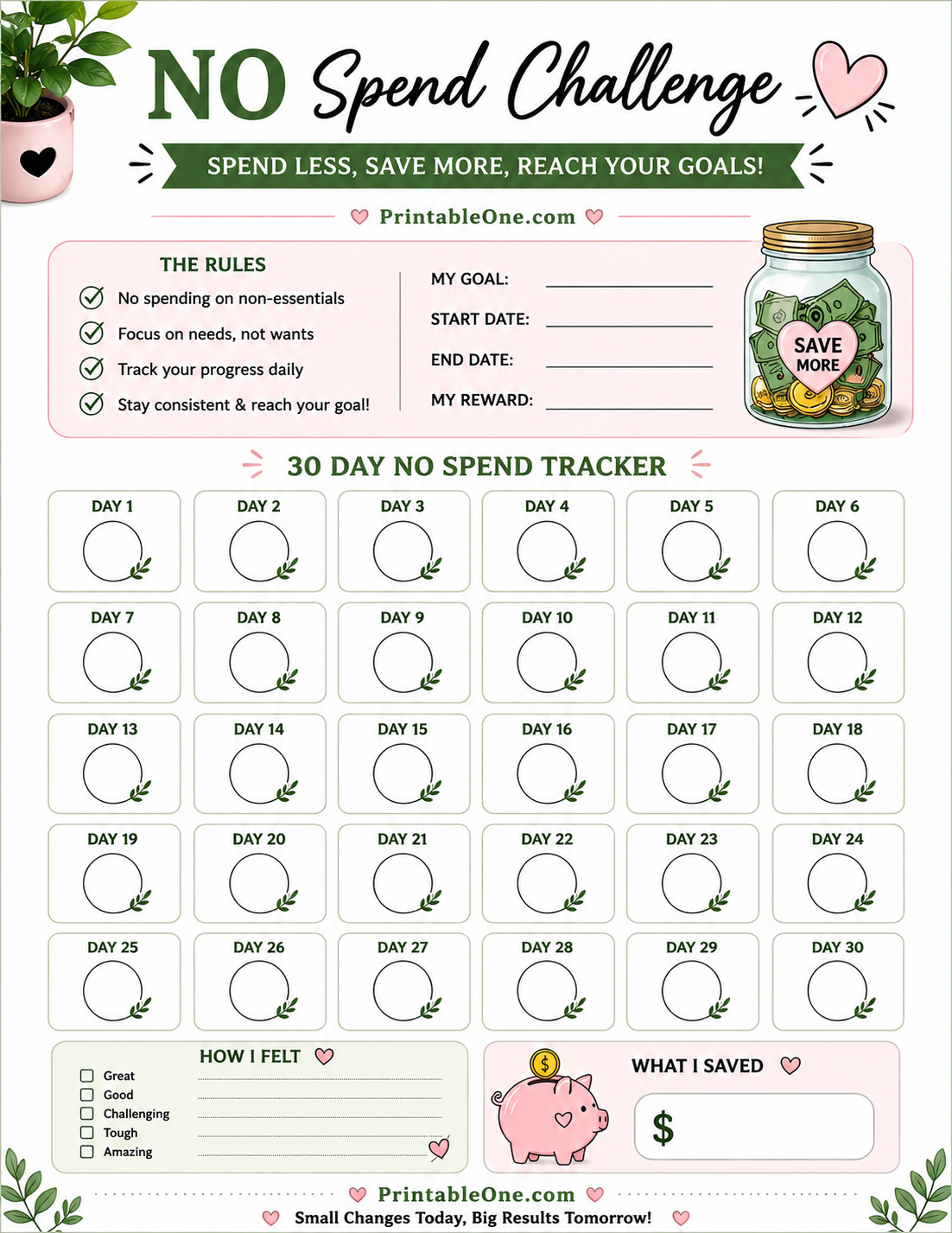
Take control of your finances with this free No Spend Challenge Printable PDF. Track your progress for 30 days, spend less, save more, and reach your financial goals.
Also Read:
- Free 52 Week Savings Challenge Printable PDF (Save $1,378 in One Year)
- Free 100 Envelope Challenge Printable PDF (Save $5,050 in 100 Days)
What Is a No-Spend Challenge?
A no-spend challenge is a structured financial exercise where you deliberately choose to avoid making any unnecessary purchases for a specific period of time. Most commonly, 30 days. It is not about depriving yourself of the things you need to survive; rather, it is a conscious effort to eliminate discretionary spending, impulse purchases, and lifestyle leaks.
Think of it as a comprehensive digital and physical detox for your wallet. For one month, you draw a hard line between true biological necessities and psychological desires. By forcing yourself to look at alternative, free ways to live, work, and play, you strip away the automated consumer habits that quietly drain your income.
To succeed, you must understand the distinction between what is allowed and what is strictly paused during the timeline:
Examples of Allowed Spending (The Essentials)
These are your fixed overhead costs and basic survival needs that must be paid to maintain your household, health, and employment:
- Housing Costs: Rent or monthly mortgage payments.
- Utilities: Electricity, water, gas, internet, and trash services.
- Groceries: Whole foods, basic ingredients, and essential household items (no luxury organic snacks or premium specialty goods).
- Transportation: Gas for your vehicle, public transit passes, or commuter tolls.
- Medical Expenses: Necessary prescriptions, doctor co-pays, and health insurance premiums.
Examples of Not Allowed Spending (The Non-Essentials)
These represent discretionary expenses that you can temporarily pause for 30 days without any negative impact on your health or safety:
- Coffee Shop Visits: Daily lattes, premium energy drinks, and cafe snacks.
- Fast Food & Restaurants: Takeout, delivery apps, workplace lunches, and weekend dinners out.
- Online Shopping: Browsing retail apps, adding clothing items to digital carts, or ordering non-essential household gadgets.
- Impulse Purchases: Random checkout-lane items, digital book downloads, app upgrades, or sale items bought simply because they were discounted.
- Entertainment Purchases: Concert tickets, movie theater outings, paid events, or arcade admissions.
How Does the No-Spend Challenge Work?
Successfully navigating a month of zero discretionary spending requires strategy rather than raw willpower. Follow this five-step process to set up your tracker and guarantee a successful financial reset.
[Set Your Goal] ➔ [Define Your Rules] ➔ [Print Your Tracker] ➔ [Track Every Day] ➔ [Celebrate Progress]Step 1: Set Your Goal
Before you drop your spending to zero, you must know exactly why you are doing it. Having a powerful psychological anchor keeps you from giving in when temptation strikes. Write your ultimate goal clearly at the top of your printable sheet. Excellent motivators include:
- Building a 3-month emergency fund for ultimate peace of mind.
- Saving up cash for an upcoming summer vacation fund.
- Aggressively wiping out a high-interest credit card balance or student loan.
Step 2: Define Your Rules
Every individual’s financial reality is unique. Sit down before Day 1 and establish your personal boundary lines. Decide exactly what counts as an allowed necessity and what is banned. If you have an unavoidable pre-planned event during the month (like a family member’s birthday), write in a specific, contained exemption for that single day so it doesn’t derail your entire challenge.
Step 3: Print Your Tracker
Download the high-quality PDF from PrintableOne.com and print it on standard US Letter paper. Do not skip the physical printout—moving the challenge off your phone screen and into the real world creates immediate psychological accountability. Hang it prominently where you face your money decisions daily.
Step 4: Track Every Day
Every evening, review your day. If you successfully avoided all discretionary spending, take a colorful marker, pen, or highlighter and color in that day’s box on your 30-day grid. Watching the blank boxes slowly transform into a vibrant chain of successful days creates a deep sense of accomplishment.
Step 5: Celebrate Your Progress
Once Day 30 is complete, review your data. Fill out the reflection section on the printable, calculate your total savings, and reward yourself with a predetermined, non-monetary treat (like a movie night at home or a relaxing day at a local park).
Benefits of a No-Spend Challenge
Why has this specific personal finance exercise captured the attention of budget communities worldwide? It yields massive structural shifts in both your bank balance and your consumer behavior.
- Save Money Quickly: Traditional budgets cut expenses by 5% or 10% over many months. A no-spend month aggressively slices out 100% of discretionary leaks instantly, providing a rapid capital injection into your savings pool.
- Build Better Money Habits: By breaking the automatic cycle of tapping your credit card for minor conveniences, you force your brain to develop new routines. You will naturally start packing lunches, brewing coffee at home, and seeking free community activities.
- Reduce Impulse Buying: We live in a hyper-optimized retail ecosystem designed to make buying friction-free. A 30-day pause acts as a behavioral pattern interrupter, breaking the immediate dopamine loop associated with modern online shopping.
- Reach Financial Goals Faster: Every dollar you avoid spending on a fleeting luxury is a dollar that can be immediately deployed toward asset accumulation, emergency funds, or debt elimination.
- Feel More In Control: Financial anxiety often stems from a feeling of helplessness. Proving to yourself that you can successfully control your spending impulses for 30 consecutive days builds immense confidence and financial self-efficacy.
What’s Included in This Printable?
We engineered this tracking sheet to be clean, functional, and completely intuitive. Your instant download package includes everything you need to document your 30-day journey on a single page:
- 30-Day No-Spend Tracker Grid: A clean, bold matrix layout numbered 1 through 30, designed for easy highlighting or stamp marking.
- Goal Section: A dedicated, prominent field to display your primary financial motivation so your eyes hit it daily.
- Timeline Prompts: Explicit Start Date and End Date fields to keep your calendar timeline firmly anchored.
- Reward Section: A space to define your non-monetary milestone reward to keep your spirits high during tough weeks.
- Savings Tracker Block: A calculations area to log the exact cash sums you successfully kept in your pocket during the challenge.
- Reflection Section: A prompt at the bottom of the page to jot down your breakthroughs, lessons learned, and habit observations at the end of the month.
- US Letter Format: Optimized layout margins tailored specifically for flawless printing on standard 8.5 × 11-inch home paper.
How Much Money Can You Save?
The ultimate monetary yield of your 30-day sprint is directly proportional to your pre-existing retail spending habits. However, when you calculate the true daily compounding impact of minor convenience expenses, the math is staggering.
Example Savings Breakdown
Take a look at how quickly small, everyday discretionary cutbacks scale over the course of a single 30-day month:
| Estimated Daily Spending Cut | Total 30-Day Cash Savings |
| $5 per day (Skipping a daily premium coffee) | $150 |
| $10 per day (Packing a home-cooked lunch) | $300 |
| $20 per day (Eliminating takeout and random app purchases) | $600 |
| $30 per day (Pausing high-end retail shopping & weekend bar trips) | $900 |
By stepping back from non-essential commerce, the average household can easily uncover $300 to $600 of hidden cash flow in a single month—money that was previously vanishing without a trace.
No-Spend Challenge Rules
To maintain absolute structural integrity throughout your challenge, align yourself with these core operational guidelines:
The Basic Ground Rules
- Buy Only True Necessities: If an item is not required to preserve your employment, home, or physical health, it is paused.
- Avoid Impulse Purchases: Implement a strict 30-day cooling-off period for any retail item that catches your eye.
- No Online Shopping: Delete shopping apps from your phone and clear saved credit card details from your web browsers to remove temptation.
- No Restaurant Spending: All meals, snacks, and drinks must be prepared using ingredients purchased during standard grocery trips.
- Track Daily Progress: Interact with your physical sheet every night without exception to keep your psychological momentum alive.
What Counts as Essential Spending? (Usually Allowed)
- Baseline grocery staples (milk, eggs, vegetables, rice, basic proteins).
- Rent, mortgage installments, and property taxes.
- Core utility bills (electricity, water, home heating, basic cellular plans).
- Auto insurance, health insurance, and life coverage.
- Vital medical needs, dental emergencies, and prescription drug costs.
- Fuel for your commuter vehicle or public transit passes to travel to work.
What Counts as Non-Essential Spending? (Usually Not Allowed)
- Specialty coffee runs, drive-thru breakfasts, and afternoon energy drinks.
- Fast food, gourmet restaurants, bar tabs, and home food delivery services.
- New clothing, shoes, fashion accessories, and cosmetics.
- Amazon orders, home decor items, and electronic entertainment upgrades.
- Premium streaming subscription additions or digital video rentals.
- Concert tickets, sporting events, and luxury spa treatments.
Tips to Successfully Complete a No-Spend Challenge
An intense 30-day lifestyle shift requires proactive preparation to prevent friction. Use these battle-tested insider strategies to safeguard your streak:
1. Plan Meals Ahead
The number one point of failure for most financial challenges is dinner time after a exhausting workday. If your fridge is empty and your energy is low, tapping a food delivery app becomes incredibly tempting. Prevent this by planning your weekly meals every Sunday, grocery shopping with a strict list, and keeping simple emergency freezer meals ready for busy nights.
2. Unsubscribe From Marketing Emails
Modern retail brands use highly optimized email newsletters and text alerts to trigger your impulse spending desires. Spend 15 minutes before Day 1 unsubscribing from every clothing, tech, and retail newsletter in your inbox. Out of sight, out of mind is your greatest defense.
3. Use Cash Only for Grocery Trips
If you struggle with adding extra luxury items to your cart while grocery shopping, leave your plastic credit cards at home. Calculate your necessary food budget, withdraw that exact amount in physical cash, and step into the store. This creates hard structural boundaries that make overspending mathematically impossible.
4. Stay Busy with Free Activities
Boredom is the primary driver of modern consumer spending. Fill your calendar with enriching, free activities. Visit your local public library for books and movies, explore nature trails at nearby county parks, host a board game night with friends at home, or dedicate time to learning a new digital skill online.
5. Track Progress Daily
Never wait until the end of the week to mark up your tracker grid. The act of physically checking off a successful day every single night provides immediate cognitive reinforcement, strengthening your resolve for the following day.
Common Mistakes to Avoid
Watch out for these behavioral traps that can derail a well-intentioned personal finance reset:
- Making Rules Too Strict: If you try to survive solely on rice and beans while cutting out internet and hot water, you will experience burnout within 72 hours. Keep your rules realistic, humane, and sustainable.
- Not Planning Ahead: Entering a no-spend month with an completely empty pantry and zero meal ideas guarantees failure. Always dedicate the weekend prior to strategic preparation.
- Forgetting Your Goal: If you treat the challenge as a meaningless exercise in self-punishment, your willpower will fade quickly. Keep your tracker sheet—and the financial dream written upon it—fully visible at all times.
- Giving Up After One Mistake: You are human, and slip-ups can happen. If you accidentally purchase a non-essential item on Day 12, do not throw your hands up and abandon the entire month. Simply acknowledge the error, log the expense, and resume your no-spend streak on Day 13.
Who Should Use This Printable?
This highly adaptive tracking framework is designed to deliver immediate value to individuals across a wide variety of socioeconomic realities and life stages.
| Targeted User Group | Direct Value Realized |
| Students | Teaches critical financial literacy, resourcefulness, and core budgeting discipline early in life. |
| Families | Transforms resource preservation into a collaborative household activity that teaches children the value of money. |
| Couples | Aligns partners on shared future milestones, encouraging open communication regarding wants vs. needs. |
| Budget Beginners | Serves as the ultimate low-barrier gateway to financial tracking without requiring complex mathematics or software. |
| Debt Payoff Journey | Acts as an accelerant to free up trapped monthly cash flow to aggressively target high-interest loan balances. |
| Anyone Wanting to Save | Provides an immediate behavioral audit to uncover exactly where money leaks exist in a monthly routine. |
Head-to-Head Comparisons: Choosing Your Financial Game
Selecting the ideal money challenge depends entirely on your current lifestyle capacity, timing constraints, and ultimate asset accumulation targets.
No-Spend Challenge vs. 52-Week Savings Challenge
| Feature | No-Spend Challenge | 52-Week Savings Challenge |
| Duration | 30 Days | 52 Weeks (1 Full Year) |
| Core Focus | Spending Less (Expense Reduction) | Saving More (Incremental Deposits) |
| Difficulty Level | Medium (Requires active daily discipline) | Easy (Gradual, low-barrier entry) |
| Best Suited For | Rapid lifestyle resets & quick savings | Long-term habit engineering |
No-Spend Challenge vs. 100 Envelope Challenge
| Feature | No-Spend Challenge | 100 Envelope Challenge |
| Primary Goal | Optimize Cash Flow / Reduce Waste | High-Volume Asset Accumulation |
| Duration | 30 Days | 100 Days (~3.3 Months) |
| Entry Cost | Free (Saves money instantly) | Requires scaling daily cash deposits |
| Best Suited For | Behavioral audits & tactical resets | Aggressive, fast-paced financial sprints |
Frequently Asked Questions
Is this no-spend challenge printable completely free?
Yes! Our premium printable tracker is 100% free for personal use. You can instantly download the file in high-resolution PDF or PNG format and print as many clean copies as you need for your personal planner or household members.
What size is the downloadable file?
The download is precisely formatted to standard US Letter size (8.5 × 11 inches). It features optimized margins designed to print flawlessly on standard home printer paper without requiring any complex sizing tweaks or margin cropping.
Can I start this challenge at any time of the year?
Absolutely. While many people enjoy launching lifestyle changes on January 1st, you do not need a new year or even a new month to take control of your destiny. Because our template features open customizable fields, you can confidently launch your 30-day reset today.
What should I do if I accidentally spend money on a non-essential item?
Do not panic and do not give up. A single impulse purchase does not nullify the progress you made on previous days. Acknowledge the slip-up, note the trigger that caused it, leave that specific day uncolored on your grid, and immediately resume the challenge the next morning.
How long should a standard no-spend challenge last?
While advanced savers occasionally execute extended multi-month sessions, the absolute gold standard for a successful behavioral reset is 30 days. This window is long enough to break negative habits and build massive cash reserves, yet short enough to remain highly sustainable.
Can couples execute this challenge together?
Yes. In fact, doing this challenge alongside a romantic partner or roommate is highly recommended. It ensures your household rules are perfectly aligned, eliminates social friction regarding weekend entertainment choices, and doubles your collective savings velocity.
Can I utilize this printable template digitally?
Yes. If you prefer a completely paperless workflow to minimize clutter, you can seamlessly import our PDF download into any digital note-taking application on your mobile device or tablet (such as GoodNotes or Notability) and track your progress using a digital stylus.
Expand Your Financial Toolset: Related Printables
True long-term wealth management requires balancing a variety of daily, weekly, and monthly money habits. Once you find your rhythm with our 30-day tracker, supercharge your long-term success by integrating our other specialized financial tracking sheets:
- 52-Week Savings Challenge Printable: The perfect year-long companion tool designed to guide you step-by-step toward a smooth $1,378 emergency cushion.
- 100 Envelope Challenge Printable: A high-octane, gamified layout engineered to help you pile up a massive $5,050 in just 100 days.
- Savings Goal Tracker Printable: A beautifully minimalist visual display to help you color-code your progression toward major life assets.
- Monthly Budget Planner Printable: A highly functional layout designed to help you balance your core income streams, fixed overhead bills, and variable monthly costs.
Final Thoughts: Take Direct Action Today
A secure, stress-free financial future isn’t built on complex economic equations or waiting around for a lottery win. Real, lasting prosperity is forged through simple, intentional daily decisions repeated with absolute consistency.
By stepping up to the no-spend challenge, you are making a bold, definitive statement that you are the master of your money—not the other way around. Those avoided coffee runs, paused retail shipments, and skipped takeout meals are not sacrifices; they are the literal brick and mortar you are using to construct your future financial freedom.
Don’t let hesitation hold you back from building the peace of mind you deserve. Download your high-resolution tracker right now, fire up your home printer, set your goal, and take that powerful first step today!